Affiliate disclosure: Some links on this page are affiliate links. If you make a purchase through them, Larkmeadow may earn a commission at no additional cost to you. Which products we describe, and how, does not depend on whether we have an affiliate relationship with the brand.
A pot of basil on the windowsill sounds simple until winter arrives, the window turns gray by 4 p.m., and the plant starts stretching toward the glass. That’s usually the moment people start comparing indoor herb garden kits and countertop smart gardens, and wondering whether the glowing, self-watering gadgets are worth it.
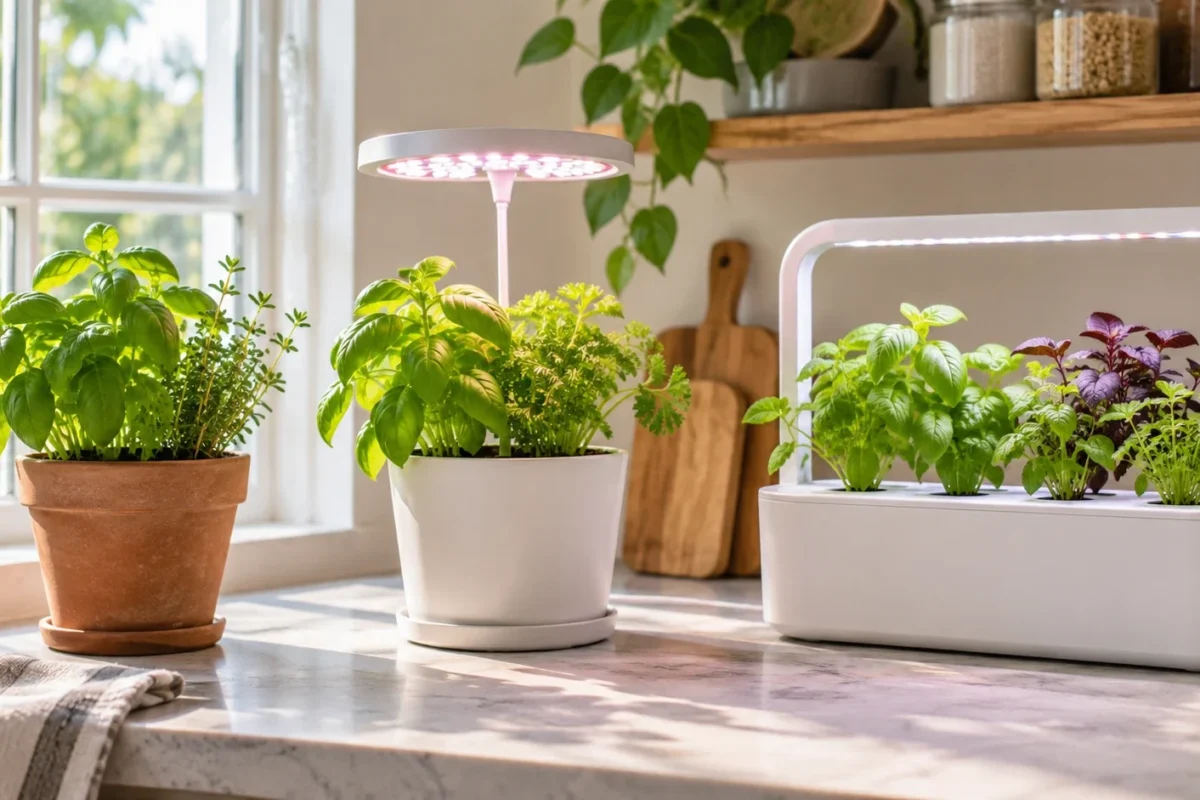
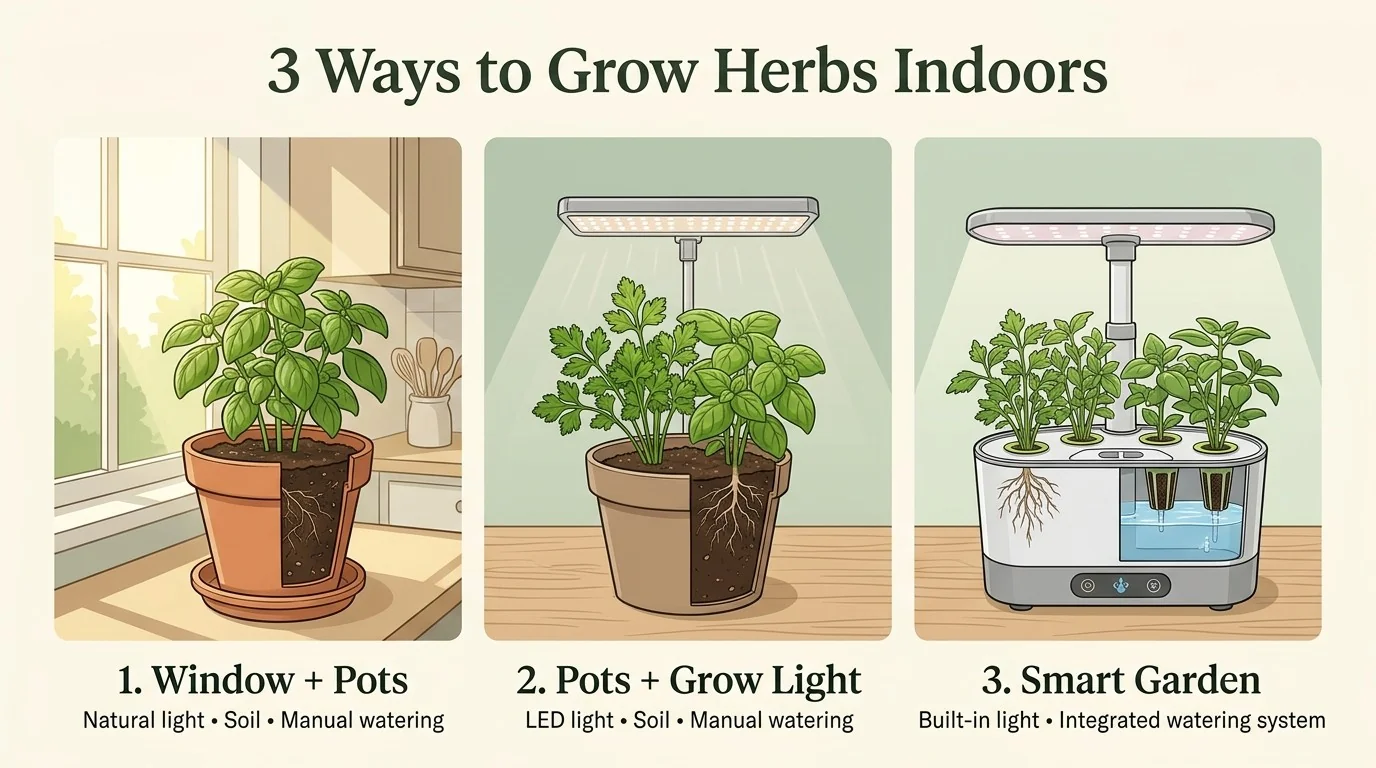
You actually have three choices: pots on a sunny windowsill, pots under an LED grow light, or an all-in-one smart garden. This guide explains how they differ, how smart gardens work, what to compare before you buy, and which setup fits which kind of home, based on university Extension guidance and manufacturers’ published specs.
If you’re brand new to growing herbs, our guide on how to start an herb garden, indoors or out covers the basics of choosing herbs, watering, and harvesting. This article focuses on the equipment.
Three Ways to Grow Herbs Indoors
1. Pots on a Sunny Windowsill
This is the classic herb kit: seeds, small pots, potting mix, and sometimes a tray or a decorative planter. It costs the least to run, because the sun does the heavy lifting.
The catch is light. Iowa State University Extension calls light “typically the most limiting factor” for indoor herbs and notes that most herbs need around eight hours of direct light a day indoors, while some tolerate as little as six. A south-facing window is best; a bright east- or west-facing window can also work. In winter, when days are short, that’s hard to hit in many homes.
A windowsill kit works best if you have that bright window, want only a few herbs, and don’t mind checking on them every few days. Iowa State also recommends letting the soil dry between waterings, using pots with good drainage (clay or terracotta pots dry out more readily), and growing each herb in its own container.
2. Pots Under an LED Grow Light
If your windows are dim, you can keep the pots and add the light. This can be as simple as a clip-on or bar-style LED over a shelf, or a plug-in LED shop light for a larger collection.
Iowa State recommends full-spectrum grow lights in high-output fixtures, placed within 6 to 12 inches of the leaves, plugged into a timer set for 12 to 16 hours a day. You still water and feed the plants the same way you would on a windowsill, but you’re no longer at the mercy of the weather.
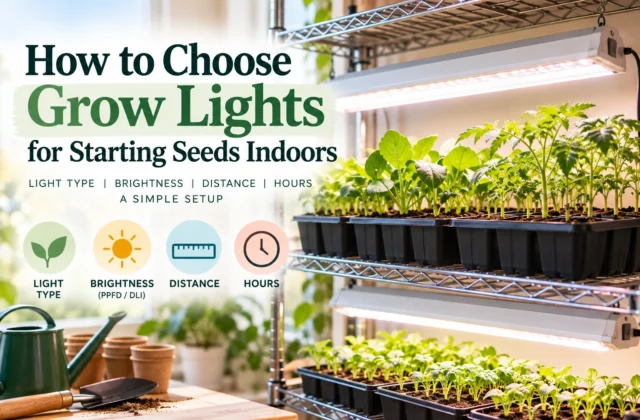
This middle option is easy to overlook, but it’s flexible: you choose every piece and can upgrade any one of them later. For help comparing fixtures, see our guide on how to choose grow lights. It’s written for seedlings, but the label basics apply to herbs too.
3. Smart Gardens (Countertop Hydroponic Systems)
A smart garden combines a water tank, a built-in LED light on a timer, and a set of planting pods into one unit. Many are hydroponic, with the roots growing in water and dissolved nutrients rather than in potting mix. Others, such as Click & Grow, use pods filled with a growing medium that draws water up from the tank through wicks. Many connect to a phone app.
Smart gardens trade flexibility for convenience. You don’t need a sunny window, and the light schedule runs itself. In return, you’re working within the unit’s size, light height, and pod system, and there are ongoing supplies to plan for.
The Three Setups at a Glance
Scroll or swipe sideways to see all columns.
| Pots + window | Pots + LED light | Smart garden | |
|---|---|---|---|
| Needs a sunny window | Yes (about 6 to 8+ hours of direct light) | No | No |
| What the roots grow in | Potting mix | Potting mix | A nutrient solution (hydroponic), or pods with a growing medium |
| Light schedule | Set by the sun | You set a timer | Built in, sometimes app-controlled |
| Watering | Water when the soil starts to dry | Water when the soil starts to dry | Refill the tank, add nutrients per the manual |
| Flexibility in what you grow | High | High | Limited by pod size and light height |
| Ongoing costs to expect | Potting mix, fertilizer, seeds | Electricity, potting mix, fertilizer, seeds | Electricity, seed pods or sponges, nutrients (unless included in the pods), replacement parts |
How Smart Gardens Work
“Smart garden” is a marketing term, not a growing method, and the units sold under that name don’t all work the same way. The biggest difference is what the roots grow in.
Hydroponic Gardens: Roots in a Nutrient Solution
Hydroponics means growing plants without soil, with the roots in a nutrient solution. University of Illinois Extension points out that the idea is old; the modern term dates to the 1930s. In a hydroponic countertop garden, you add water and the brand’s nutrient product to the tank, and the plants grow from small baskets or sponges with their roots reaching into that solution.
Hydroponic gardens come in two basic styles:
- Pumped systems use a small pump to circulate the solution on a schedule. LetPot, for example, describes a pump that runs at 30-minute intervals on its Air model.
- Non-circulating (passive) setups let the roots sit in a still solution with no pump. UF/IFAS Extension describes this “set it and forget it” approach, often called the Kratky method, as needing no electricity for pumps or aerators.
Simpler kits exist, too. Modern Sprout’s Garden Jars, for example, use what the brand calls an immersion hydroponic setup with a net pot; check each product’s details to see how it supplies water and nutrients.
Smart Soil Gardens: Pods With a Growing Medium
Click & Grow takes a different approach. Its pre-seeded Plant Pods are filled with a growing medium the brand calls Smart Soil, and the brand says the pods take care of seeds, nutrients, pH, and moisture. Water rises from the tank into the pods through wicks, with “no pumps,” and Click & Grow says you refill the tank every 1 to 3 weeks. Setup, in the brand’s words, is: add the pods, add water, and plug it in.
Click & Grow itself draws the line between the two methods. It describes hydroponic systems as ones “where plant roots sit directly in a nutrient solution,” and says its gardens need less frequent cleaning than those systems.
In practice, that means:
| Hydroponic garden | Smart Soil garden (Click & Grow) | |
|---|---|---|
| What the roots grow in | A nutrient solution, from baskets or sponges | Pods filled with a growing medium |
| How water reaches the roots | A pump, or roots resting in still solution | Wicks drawing water up from the tank |
| Nutrients | Added to the tank on the manual’s schedule | Supplied by the pods, according to the brand |
| What you plant | Seed pods or sponges you seed yourself (varies by brand) | Pre-seeded pods, or seedless pods for your own seeds |
Either way, the plants still need two things a winter windowsill often can’t give them: enough light and the right supply of nutrients.
A Note on pH, EC, and How Often to Change the Water
Advice on hydroponic upkeep varies a lot, mostly because each source is written for a different kind of setup. Match the advice to the equipment:
- Small homemade systems (Illinois Extension): Written for small home hydroponic setups built from simple supplies (its example is a homemade passive system in a shallow 3-gallon tub). For those, Illinois Extension recommends testing the pH and EC (electrical conductivity, a measure of nutrient strength) weekly, changing the water completely every 2 weeks, and keeping the pH in the 5 to 6 range where most plants in a hydroponic setup do well. It also advises against water from a water softener.
- A non-circulating bucket of lettuce (UF/IFAS): Written for lettuce grown in a 5-gallon bucket, set outdoors in a sunny spot during Florida’s cool season. Set up that way, UF/IFAS says, the solution rarely needs its pH or nutrients adjusted before harvest. The guidance is for lettuce and similar short, low-profile crops, not for every herb or every indoor setup.
- Countertop smart gardens (the manufacturer): Follow the manual for your unit. Neither Extension source above was written for commercial countertop gardens, and each brand designs its refill, nutrient, and cleaning schedule around its own system.
UF/IFAS adds that growing hydroponically indoors year-round requires adequate lights and a fan, which raises costs and makes troubleshooting more complex. A smart garden covers the light; the fan is worth keeping in mind for a stuffy room.
What to Compare Before You Buy
Whichever setup you’re leaning toward, these are the points to check.
Light Output and How High the Light Goes
On a smart garden, the light is built in, so its brightness and maximum height matter. Wattage is listed on most spec sheets, but it’s a rough guide rather than a measure of how much usable light reaches the leaves. Height matters too, because herbs keep growing upward while the light stays where the frame allows. Check the maximum light height, or whether extension arms are available.
For a pot-and-light setup, you control both. Iowa State’s 6-to-12-inch guideline is a useful starting point.
Capacity and Plant Size
Smart gardens are usually described by the number of pods, from 3 up to 30 or more. More pods aren’t automatically better. Think about what you actually cook with. A few herbs you use every week may serve you better than a dozen you rarely touch.
Pots win on flexibility here. Iowa State notes that containers should be sized to the plant, since pots that are too large stay wet too long.
Seed Pods: Pre-Seeded Only, or Your Own Seeds Too?
This is one of the biggest long-term differences between brands. Some systems are built around pre-seeded pods; others use sponges and baskets you plant yourself.
Click & Grow uses pre-seeded Plant Pods and also sells seedless “Grow Anything” pods that you plant with your own seeds. LetPot sells seed pod refill kits and grow sponge refill kits for its systems. Before you buy any smart garden, check what refills it uses, whether you can plant seeds from any source, and which herbs the brand offers in pod form.
Water, Nutrients, and Weekly Upkeep
With pots, upkeep means checking the soil and watering when it starts to dry. Iowa State suggests light feeding with an all-purpose fertilizer at half or quarter strength from early spring through summer, and no feeding in winter.
With a smart garden, upkeep means topping up the tank and following the manual’s schedule for nutrients and cleaning. Tank size affects how often you refill. Some units warn you when the water runs low. LetPot, for example, describes low-water alerts in its app and, on some models, on the device itself.
App, Wi-Fi, and Subscriptions
Apps can be handy for light schedules and refill reminders. Before you buy, ask:
- Does the garden work without the app if your Wi-Fi changes or the app stops being updated?
- Does it use Wi-Fi, Bluetooth, or both?
- Are any features tied to a paid plan?
Manufacturers answer these differently. LetPot’s product page for its LPH-Home says no app subscription is required. Gardyn lists a membership program on its site, so check what it includes and which features depend on it. Click & Grow’s Smart Garden 9 PRO adds Bluetooth light scheduling in the brand’s app.
Ongoing Costs to Expect
Prices change often, so here’s what to budget for instead:
- Pots and window: potting mix, fertilizer, seeds or transplants
- Pots and LED light: the above, plus electricity for the light and, eventually, a replacement light
- Smart garden: electricity, seed pods or sponges, nutrients (some brands build them into the pods), and replacement parts like lamps, pumps, or floats
Check the price of refills, not just the garden itself, before you decide.
Noise, Light Spill, and Where It Will Sit
A smart garden’s light may be on for 12 to 16 hours a day in a room you live in. Click & Grow, for example, runs its lights 16 hours on and 8 hours off. Consider where the light will shine at night, whether you’ll hear a pump in a quiet room, and whether the unit will sit near an outlet. Wick-based gardens have no pump; pumped units vary. Few manufacturers publish noise measurements, so if quiet matters, look for a stated figure or a way to switch the pump or light off on a schedule.
Smart Garden Specs Side by Side
The table below compares countertop models from two brands using the manufacturers’ published specs, so you can see how the numbers vary. It isn’t a ranking, and it doesn’t include prices, which change often. Larkmeadow has an affiliate relationship with LetPot and not with Click & Grow. That doesn’t change which specs we list.
Specs from manufacturer product pages, checked November 2026. Confirm current details before buying.
Note: Listed power isn’t measured the same way across models: Click & Grow lists each garden’s power consumption, LetPot lists the light board’s power for the LPH-SE and LPH-Max, and LetPot lists the LPH-Mini’s overall power. Treat it as a rough guide, not a direct comparison of light output.
Scroll or swipe sideways to see all columns.
| Model | Pods | Listed power (see note) | Water tank | Max light height | Root zone & watering | Controls |
|---|---|---|---|---|---|---|
| Click & Grow Smart Garden 3 | 3 | 8 W | Unconfirmed (the product page lists both 1.5 L and 1.2 L) | Not stated (extension arm sold separately) | Smart Soil pods; wicks, no pump | Auto light cycle; care-tips app |
| Click & Grow Smart Garden 9 | 9 | 13 W | 4 L | Not stated (extension arms sold separately) | Smart Soil pods; wicks, no pump | Auto light cycle; care-tips app |
| Click & Grow Smart Garden 9 PRO | 9 | 13 W | 4 L | Not stated | Smart Soil pods; wicks, no pump | Bluetooth app + touch light controls |
| LetPot LPH-Mini | 5 | 10 W | 1.5 L | 16.3 in (adjustable from 4.3 in) | Hydroponic; pump | App |
| LetPot LPH-SE | 12 | 24 W | 5.5 L | 30 in | Hydroponic; pump | App + touch panel |
| LetPot LPH-Max | 21 | 36 W | 7.5 L | 30 in | Hydroponic; pump; optional external tank for auto-refill | App + touch screen |
Larger systems also exist. LetPot’s LPH-Home has 32 sites, two 6-liter tanks, and separate lights for its two tiers. Gardyn makes vertical systems sized for 16 or 30 plants. AeroGarden, part of ScottsMiracle-Gro, also makes countertop gardens. In a May 2026 post, ScottsMiracle-Gro said AeroGarden is not out of business and that its seed pods, accessories, and gardens are in stock.
Which Setup Fits You?
A Simple Windowsill Kit Suits You If…
- You have a south-facing (or very bright east or west) window
- You want two or three herbs and don’t mind checking the soil
- You’d like the lowest running cost and no electronics
A Pot-and-Light Setup Suits You If…
- Your windows are dim or you want to grow in winter
- You want to choose your own pots, soil, and seeds
- You’d like to scale up gradually, perhaps with a shelf and a longer light
- You want to grow herbs that need a deeper pot or a different watering routine than their neighbors
A Smart Garden Suits You If…
- You have little or no window light, such as in a basement apartment or an interior kitchen
- You value a fixed routine: refill the tank, add nutrients, harvest
- You want a self-contained unit that looks tidy on a counter
- You’re comfortable with ongoing pod or sponge refills and with following the manual’s nutrient schedule
- You’re looking for a gift that’s ready to plant right out of the box
Herbs That Do Well in Each Setup
Iowa State names parsley, mint, chives, basil, oregano, cilantro, and thyme as herbs that handle indoor conditions well. It lists rosemary, sage, lemon balm, marjoram, and chervil as next steps because they need more light or are prone to pests such as spider mites indoors.
For hydroponics, Illinois Extension says lettuce is the easiest crop in a homemade passive setup, and that basil, cilantro, kale, and other greens can also be grown. It suggests starting with one type of plant until you learn how your system behaves. For smart gardens, check the brand’s pod list to see which herbs it offers and recommends.
Two more things to keep in mind. Iowa State notes that many indoor herbs aren’t as intensely flavored as those grown outside, though basil still tastes like basil. And if you have cats or dogs, check each herb before you bring it home. Our herb garden guide explains why Penn State Extension advises skipping tarragon in homes with pets, and our guide to pet-safe houseplants covers how to check a plant’s toxicity.
Frequently Asked Questions
Are smart gardens worth it?
They can be, if you lack a bright window and want a low-effort routine. They’re less of a fit if you have good window light, want to grow a wide range of plants, or would rather avoid ongoing refills.
Can you grow herbs indoors without a grow light?
Yes, if you have a bright window. Iowa State says most herbs need around eight hours of direct light a day indoors, and some get by with six. Winter is the hardest season, so many people add a light from late fall to early spring.
Do smart gardens need special seed pods?
It depends on the brand. Some are built around pre-seeded pods; many also sell blank pods or sponges for your own seeds. Check before you buy.
How often do you change the water in a hydroponic herb garden?
For a homemade, small-scale system, Illinois Extension recommends changing the water completely every 2 weeks and checking pH and EC weekly. For a countertop smart garden, follow the manufacturer’s manual, since refill and cleaning schedules are designed for each unit.
Do smart gardens make noise?
Wick-based gardens have no pump. Pumped gardens run their pumps on a cycle, and few brands publish noise figures, so check the spec sheet if the garden will sit in a quiet room.
Getting Started
Start with your window. If it gets six to eight hours of direct sun, a simple windowsill kit is the easiest place to begin. If it doesn’t, decide whether you’d rather build a flexible pot-and-light setup or buy a self-contained smart garden. Then compare light height, pod system, upkeep, and refill costs.
Whichever you choose, our guide on how to start an herb garden will help you pick herbs and keep them productive, and our guide on how to choose grow lights explains what to look for on a light’s label.
Sources
- Iowa State University Extension and Outreach: Growing Herbs Indoors
- University of Illinois Extension: Home Hydroponics
- UF/IFAS Extension: HS1488, “Set It and Forget It” Hydroponic Lettuce
- Click & Grow product pages: Smart Garden 3, Smart Garden 9, Smart Garden 9 PRO
- LetPot product pages: LPH-Mini, LPH-Air, LPH-SE, LPH-Max, LPH-Home
- Modern Sprout: Garden Jars
- Gardyn: mygardyn.com
- ScottsMiracle-Gro: Fresh News: AeroGarden Is Back in Business (And Growing)