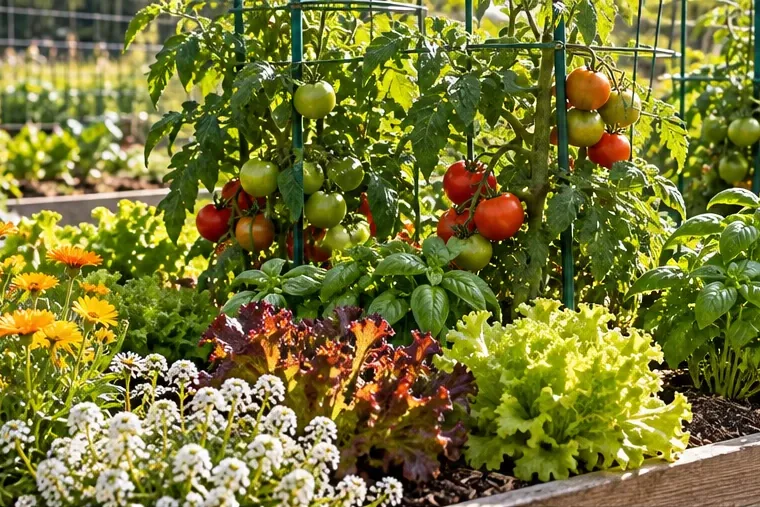
If you’ve ever looked up what to plant next to your tomatoes, you’ve probably found a companion planting chart: a grid of vegetables, herbs, and flowers marked as “friends” or “enemies.” Charts like these are everywhere, and Washington State University Extension describes popular companion planting advice as complicated, contradictory, and confusing.
So does companion planting work? Mississippi State University Extension sums it up: sometimes yes, sometimes no, and other times maybe. Some pairings have been tested and shown to help. Others have little or no research behind them.
This guide sorts the two apart, and shows how to plan a garden around the parts that work. If you’re still setting up your first plot, start with our beginner’s guide to starting a vegetable garden.
What Is Companion Planting?
Mississippi State Extension describes companion planting as growing certain plants together, or close to each other, for a shared benefit, such as improving nutrients, pollination, or crop yields.
Researchers usually call this intercropping (growing two or more crops in the same space at once) or polyculture (a more complex mix of species). Washington State University Extension notes that the science behind these practices is substantial, but most popular books, charts, and websites about companion plants lack credible support.
A helpful way to think about it: plants don’t have friendships, but every plant changes the light, water, nutrients, and insect life around it. Companion planting means arranging plants so those effects work in your favor.
What Companion Planting Can Actually Do
Extension sources point to a handful of real benefits. None is automatic: results depend on your local pests, how you arrange plants, and when you plant.
Use Space More Efficiently
University of Minnesota Extension suggests planting quick, early crops such as lettuce, spinach, or basil, then setting tomato or pepper transplants into the same bed as the early crop matures. Mississippi State notes that pairing early- and late-season crops this way also helps with weeds, because the soil stays covered longer.
Root depth matters too. Washington State suggests mixing taprooted vegetables like carrots and radishes with crops that have shallow, spreading roots, such as onions, lettuce, and corn, so their roots compete less.
Attract Beneficial Insects
Predators eat pest insects, and parasitoids are tiny wasps and flies that lay their eggs inside pests. UMass Amherst’s Center for Agriculture, Food, and the Environment lists basil, cilantro, dill, fennel, and parsley among the plants that give these beneficial insects food and shelter.
Flowers help too. Minnesota Extension points to syrphid flies (hover flies): their larvae eat many aphids, and flowers draw the adults in to lay eggs nearby.
Pull Pests Away With Trap Crops
A trap crop is a plant that a pest prefers over the crop you’re protecting. Pests gather on it, where they’re easier to deal with, but only if you manage them (see below).
Make Your Crops Harder for Pests to Find
Some pests find host plants by sight. Minnesota Extension explains that a plot of one crop is easier for insects to locate than a mix of heights, colors, and textures. Washington State adds that research points to surrounding green, non-host plants as a key factor: insects land on the wrong plants and waste time searching.
Variety within a single crop can help, too. UMass describes a University of California experiment in which aphid infestation decreased as the number of broccoli varieties in the test plots increased.
Add Legumes for Soil Health
Peas, beans, clover, and other legumes can take nitrogen from the air, a process called nitrogen fixation. Mississippi State and Minnesota Extension both note that growing legumes, as a crop or as a cover crop under another crop, can reduce how much fertilizer you need. One caution from Washington State: legumes enrich the soil and its microbes, but they don’t feed nitrogen directly to their neighbors, and they don’t always improve the health of nearby plants.
Companion Planting Combinations Worth Trying
The first six combinations have some research behind them, mostly summarized by Minnesota Extension; the last two are Extension planting guidance. A result from one study, pest, and region isn’t a guarantee for your garden, so treat this table as a starting point.
| Combination | Effect observed in research (or Extension guidance) | Notes and conditions |
|---|---|---|
| Blue Hubbard squash as a trap crop near squash, pumpkins, and cucumbers | Draws squash bugs, squash vine borers, and cucumber beetles away from the main crop (Lincoln University IPM; Minnesota Extension) | Trap plants must be larger than the main crop, and pests on them must be killed or removed |
| Spicy mustard-family plants (arugula, mustard, napa cabbage) as trap crops near cabbage-family crops | Effective trap crops for flea beetles (Minnesota Extension) | Mixes of 3 or more trap crop species reduced flea beetle damage more than a single species |
| Squash or pumpkins with nasturtiums | Reduced squash bugs; in an Iowa study, nasturtiums and marigolds reduced squash bug and cucumber beetle damage (Minnesota Extension) | Based on a small number of studies |
| Broccoli with thyme, onions, and nasturtiums; cabbage with marigolds, onions, and nasturtiums | Reduced cabbage looper and imported cabbageworm damage (broccoli: an Iowa study; cabbage: a separate study) (Minnesota Extension; Mississippi State) | Each was tested as a group of companions, not single plants |
| Tomatoes with basil and marigolds | Reduced thrips in a few field and greenhouse studies (Minnesota Extension; Mississippi State) | Limited evidence; flavor improvement isn’t supported (see Myths) |
| Squash with African marigolds and sweet alyssum | More natural enemies of aphids and a slight yield increase in a Florida study (Minnesota Extension) | One study, under Florida growing conditions |
| Lettuce or spinach before tomatoes or peppers in the same bed | Recommended by Minnesota Extension and Mississippi State to use space efficiently and keep soil covered against weeds | Extension guidance rather than a measured study result; plant the later crop as the early crop matures |
| Radishes and carrots side by side | Named by Minnesota Extension as a space-saving pairing and by UMass as an example of interplanting | Extension guidance, not a measured study result; no pest-control effect reported. Our suggestion: pull the quick-growing radishes promptly so the carrots have room |
Blue Hubbard Squash for Squash Pests
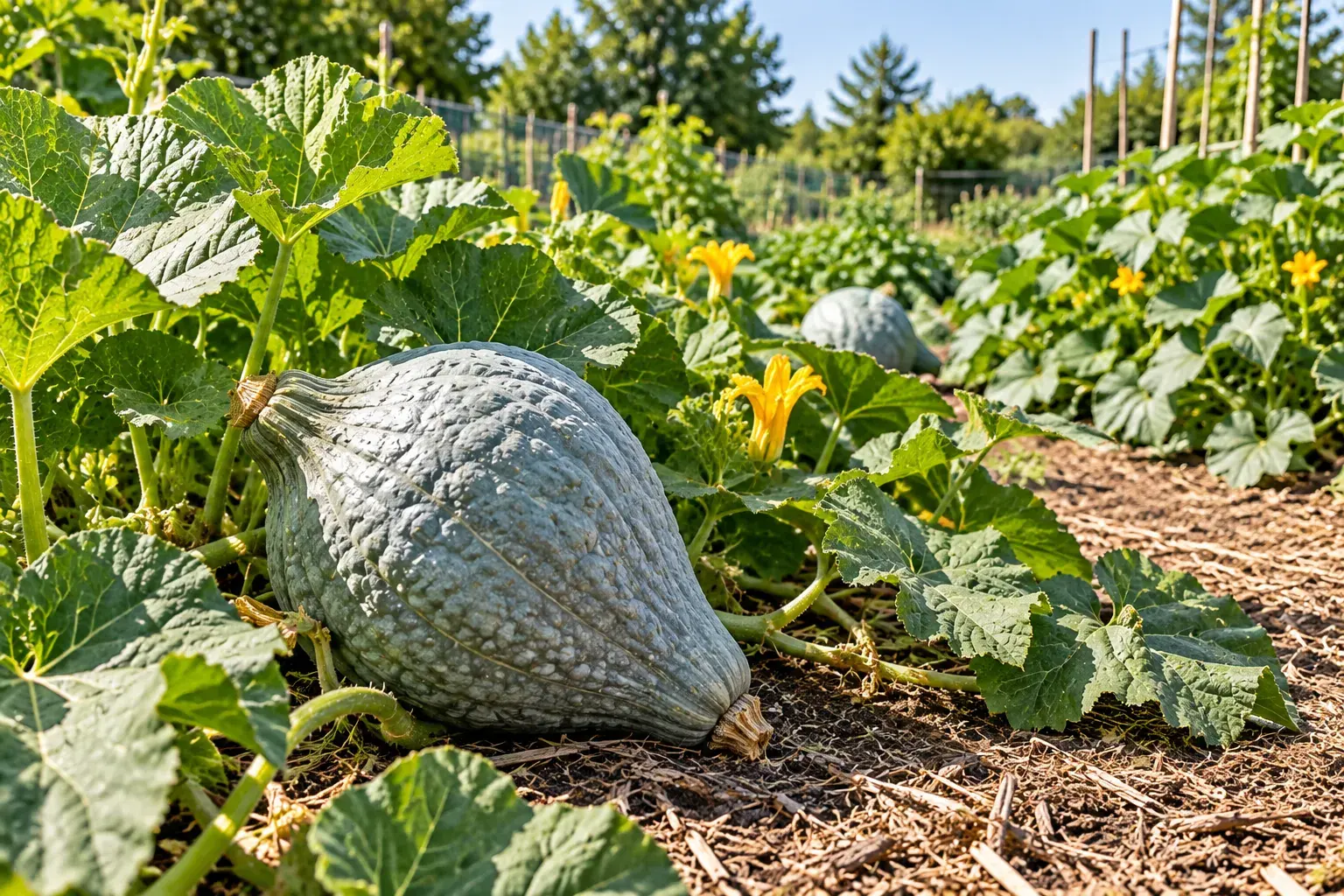
Research by Lincoln University’s integrated pest management (IPM) program, published through University of Missouri IPM, found that Blue Hubbard squash is very attractive to squash bugs, squash vine borers, and spotted and striped cucumber beetles. The trap plants go at the edges or corners of the planting and need to be bigger than the crop you’re protecting: the researchers set out two-week-old Blue Hubbard seedlings when sowing the main crop’s seeds, or at least two weeks before transplanting it.
The same source reports that 6 to 8 Blue Hubbard plants were enough to protect about 100 cucurbit plants (squash, pumpkins, cucumbers, and their relatives) in its research. Treat that as a guide for those conditions only. The source doesn’t say how many trap plants a garden with just a few squash plants needs, so the same ratio may not apply.
Most importantly, a trap crop isn’t “plant it and forget it.” The researchers stress that pests gathering on the trap plants must be killed, or they can breed there and move onto your main crop. Their guidance uses insecticides applied only to the trap plants, plus checking both trap plants and the main crop at least once a week. Trap crops also work less well when short of water or nutrients, so care for them like the main crop.
Flowers Near Your Vegetables
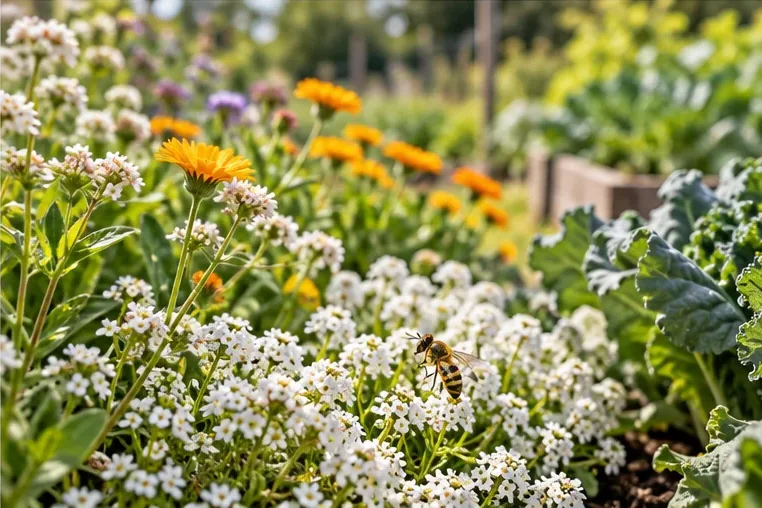
Minnesota Extension notes that a wide variety of food and habitat for beneficial insects often helps reduce pests. In one study it summarizes, planting buckwheat, cowpeas, and sunn hemp with sweet corn increased the predators and parasitoids of the corn earworm. Washington State adds that limiting companion plants to just a few species can result in little or no pest control.
Popular Companion Planting Myths
Myth: Basil Makes Tomatoes Taste Better
Garden-scale research at West Virginia University didn’t support this. In double-blind taste tests run over three years, tasters showed no consistent preference for tomatoes grown with companion plants over tomatoes grown alone.
The same research did find a yield advantage when tomatoes or Brussels sprouts were grown with basil, based on a combined measure that compares mixed plantings with each crop grown alone, not on tomato yield by itself. The advantage was largest at high planting densities with plenty of basil. The researcher concluded that such benefits don’t come simply from combining compatible plants: density, crop ratio, and planting times all mattered. Basil can still earn a spot near your tomatoes, for example as one of the herbs UMass lists for beneficial insects. Just don’t expect better flavor.
Myth: Marigolds Keep All Pests Away
The evidence for marigolds is mixed, and results depend on the type of marigold, the pest, and how they’re used:
- Nematodes. Mississippi State cites one study, and UMass describes research, showing that African and French marigolds produce compounds that can kill root-feeding nematodes (microscopic, worm-like soil organisms). In both sources, the benefit came after the marigolds were grown, as a cover crop in the UMass description, and then tilled into the soil, not from marigolds simply growing beside vegetables. Neither source names the nematode species or the amount of marigold needed, so results may vary.
- Some specific pests. Studies summarized by Minnesota Extension and Mississippi State found fewer thrips on tomatoes and fewer cabbage worms on cabbage when marigolds were planted with other companions.
- Pests they don’t seem to stop. Minnesota Extension notes that multiple studies have shown marigolds don’t deter Colorado potato beetles, and there’s little research behind using them against flea beetles.
- A trade-off. Washington State notes that French marigolds can have a negative effect on pests such as codling moths, but they also discourage those pests’ natural enemies and other beneficial insects.
UMass notes that, apart from the nematode effect, very little evidence supports marigolds’ reputation as garden “superheroes.” Grow them for color and diversity, not as an all-purpose repellent.
Myth: Strong-Smelling Herbs Repel Pests
Mint, rosemary, garlic, and other aromatic plants are often recommended as repellents. Washington State explains that while their scent compounds can repel insects in the lab, field research hasn’t shown the same effect for mint or any other aromatic plant, because the scents fade quickly with distance in open air. A greenhouse may be different, but in a backyard garden the effect is unlikely to matter.
Myth: Companion Planting Charts Are Based on Science
Washington State notes that some “friends and enemies” ideas trace back centuries to beliefs linking plants with the four elements and the zodiac. UMass adds that rigorous studies are few compared with the many anecdote-based charts. A chart isn’t always wrong, but it isn’t evidence.
The Three Sisters: A Tradition, Not a Myth
The Three Sisters, corn, beans, and squash grown together, is a traditional Indigenous growing system that many Native American communities, including the Pueblo, Mandan, and Iroquois (Haudenosaunee) peoples, have used for hundreds of years. Minnesota Extension notes that the model first emerged in Mesoamerica and remains the foundation of milpa farming there today. Its cultural and historical importance stands on its own.
Each plant has a role in the design: corn gives the beans something to climb, beans are legumes, and broad squash leaves shade the soil, helping keep it moist and suppress weeds. UMass notes that the three grow well in the same space, though they still compete for nutrients. These roles explain the design; they aren’t measured gains in yield or soil quality.
Modern research has tested something narrower: specific effects such as yield and soil quality. Washington State notes that few peer-reviewed studies exist and their results are mixed. Some found more total food per area of land, though in one study the beans and squash each yielded less than when grown alone; Washington State adds that this measure has little practical value in a small home garden. Another study found no significant differences in plant nutrients or soil. Washington State’s conclusion: no compelling published evidence that the method improves productivity or soil quality, while recognizing the historic and cultural reasons to grow it.
If a Three Sisters garden appeals to you, grow one; just don’t count on bigger harvests.
How to Plan a Companion Planting Garden
These steps are Larkmeadow’s practical suggestions based on the research above; where a step comes from a specific source, it’s named.
- Start with one problem. Pick a pest you’ve had trouble with, such as squash bugs or flea beetles, and try a combination studied for it.
- Plan for sun, height, and timing. Keep tall crops from shading sun-loving plants, and pair crops that mature at different times. If you’re planning a raised bed, sketch where each plant goes before you buy seeds or transplants.
- Spread crops out. Washington State suggests separating plants of the same kind as much as possible, so a pest that finds one doesn’t find them all.
- Add several kinds of flowers. Washington State recommends a wide variety of flowering companions, since relying on just a few species can mean little or no pest control.
- Give trap crops a head start. Trap plants need to be bigger than your main crop. If you start seeds indoors, our guide to starting vegetable seeds indoors walks through the process.
- Take notes. UMass suggests treating your own observations as a starting point. Record what you planted, where, and what happened, then see whether the results repeat next year.
Common Mistakes to Avoid
- Trusting a chart over your own garden. Treat charts as ideas to test.
- Crowding plants. Washington State notes that more plants in the same space means less water and fewer nutrients for each one.
- Ignoring pests on trap crops. According to the Lincoln University research, pests left on trap plants can breed there and move to your main crop.
- Using broad-spectrum insecticides. Washington State warns that these also kill the predators and parasitoids you’re trying to attract.
- Choosing aggressive or invasive plants. Washington State advises against invasive species and even aggressive native plants, which can outcompete your vegetables.
Frequently Asked Questions
What can I plant with tomatoes?
A few studies summarized by Minnesota Extension and Mississippi State found that basil and marigolds reduced thrips on tomatoes. West Virginia University research also found an overall yield advantage when tomatoes were grown with basil, depending on planting density and the ratio of each crop. You can also grow lettuce or spinach in the bed before your tomatoes go in. None of these is guaranteed, and basil hasn’t been shown to improve tomato flavor.
Do marigolds keep bugs away?
Not as an all-purpose repellent. Marigolds have reduced certain pests in specific studies, and research cited by Mississippi State and UMass found that African and French marigolds could kill root-feeding nematodes after being grown and then tilled into the soil. But studies found they don’t deter Colorado potato beetles, and French marigolds can also discourage beneficial insects.
Does companion planting work in raised beds or containers?
The sources here focus on garden beds, and ideas like mixing crops and adding flowers work in raised beds too. In containers, our suggestion is to keep pairings simple, since the plants share a limited amount of soil and water. Our balcony and container vegetable gardening guide covers container sizes and potting mix.
Getting Started
Companion planting works best as a set of tools, not a rulebook. Pick one problem, try one combination with research behind it, add a mix of flowers, and keep notes.
Planning your first garden? Our guide to starting a vegetable garden covers the basics.
Sources
- Mississippi State University Extension: Companion Planting: Myth or Truth?
- University of Minnesota Extension: Companion planting in home gardens
- UMass Amherst Center for Agriculture, Food, and the Environment: Companion Planting in the Vegetable Garden
- Washington State University Extension: Gardening with Companion Plants (EM128E)
- University of Missouri Integrated Pest Management (Lincoln University IPM program): Trap cropping
- West Virginia University: Yield, pest density, and tomato flavor effects of companion planting in garden-scale studies incorporating tomato, basil, and Brussels sprout (Michael K. Bomford, 2004)