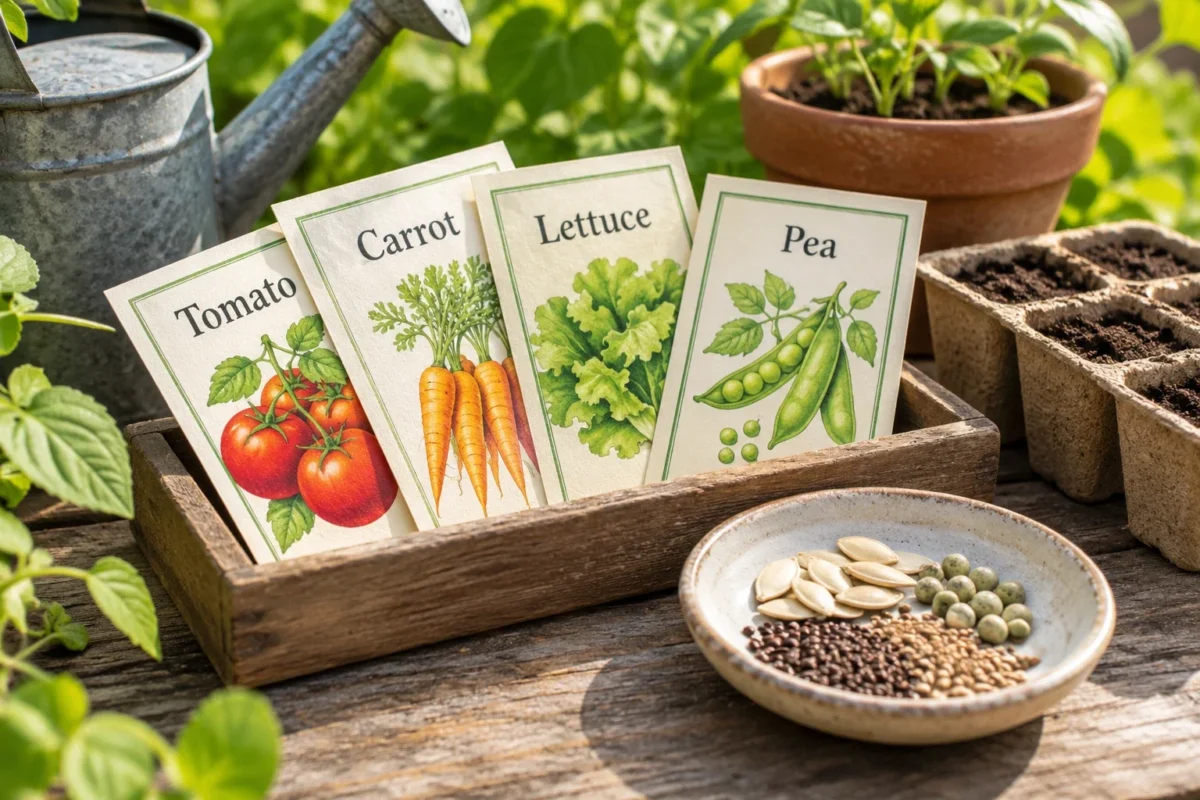
Seed catalogs tend to arrive in the middle of winter, right when the garden feels furthest away. Flipping through them is half the fun, but it can also be overwhelming: dozens of companies, thousands of varieties, and packet labels full of terms like F1, OP, heirloom, treated, and certified organic.
There isn’t one best place to buy vegetable seeds. The right source depends on what you want to grow, where you live, and whether you care about things like organic certification or saving your own seed. This guide explains the main types of seed sellers, what to look for before you order, what U.S. seed packets are actually required to tell you, and how to check whether last year’s leftover seeds are still worth planting.
We haven’t bought from or grown seed from the companies mentioned here as part of this guide, so you won’t find a ranking. Everything below comes from federal seed regulations, university Extension publications, and the companies’ own published information, checked in November 2026.
Types of Seed Sellers
Most home gardeners buy from one or more of these kinds of sources. None is automatically better; they just suit different needs.
Large Catalog and Online Seed Companies
These companies sell a wide range of vegetables, herbs, and flowers, often alongside tools and seed-starting supplies. A broad catalog makes it easy to fill a whole garden plan in one order. Clemson Extension notes that most seed companies have websites where you can request a catalog or shop online, and that catalogs usually offer a greater selection than many local seed and garden centers.
Regional and Smaller Seed Houses
Some smaller and regional companies focus on varieties suited to a particular climate or growing region. If you garden somewhere with a short season or unusually hot summers, a seller that trials and describes varieties for conditions like yours can make choosing easier.
Organic Specialists
Some companies sell only certified organic seed. If organic certification matters to you, a specialist saves you from checking each listing one by one. (See “Organic, Untreated, or Treated Seed” below for what the label means.)
Nonprofit Seed-Saving Organizations
Nonprofit groups preserve and share heirloom and open-pollinated varieties. Seed Savers Exchange, for example, describes itself as a 501(c)(3) nonprofit, founded in 1975, that collects, regenerates, and shares heirloom seeds. Buying from groups like these is one way to find older varieties you may not see elsewhere.
What to Look For Before You Order
Varieties That Fit Your Season and Region
Start with your growing season, not the catalog photos. Clemson Extension describes “days to maturity” as the average number of days from planting seed or setting out transplants to the first expected harvest, and notes that it can vary a lot with weather, temperature, and growing conditions. Treat it as a comparison tool between varieties rather than a promise.
To see how long your season really is, work from your average last and first frost dates. Our seed-starting calendar shows how to count back from your last frost date for crops you’ll start indoors. You’ll also see USDA hardiness zones in catalogs; those describe winter cold and matter most for perennials. Our guide to USDA hardiness zones explains what a zone does and doesn’t tell you.
Clear Variety Descriptions
A good catalog entry tells you more than the variety name. Look for days to maturity, plant habit (for tomatoes, determinate or indeterminate), and disease information. Clemson Extension points out that “resistance” and “tolerance” mean different things: resistance is an inherited ability to prevent or significantly reduce infection, while tolerance is the ability to grow and yield acceptably despite infection. Catalogs often use letter codes for the diseases a variety resists, so check the key in the catalog or on the website.
Organic, Untreated, or Treated Seed
These three terms describe different things, and they’re easy to mix up.
- Certified organic seed comes from plants grown under the USDA National Organic Program. Clemson Extension explains that the words “Certified Organic” on a packet mean the seed meets the program’s rules, including management under an approved Organic System Plan and inspection by a USDA-accredited certifier.
- Treated seed has been coated or otherwise treated, usually to protect it from seed- or soil-borne diseases. Under federal rules (7 CFR 201.31a), treated vegetable seed must be labeled, in type no smaller than 8 point, to show that it has been treated and to name the substance or describe the process used. WSU Extension notes that treated seed is often dyed a bright color, such as pink or blue, so it’s easy to tell apart from untreated seed.
- Untreated seed has no seed treatment. It may or may not be organic.
If you’re shopping for organic seed specifically, it helps to know what the organic rules actually say. The National Organic Program standard for seeds (7 CFR 205.204) applies to certified organic producers, not to home gardeners. It requires organic producers to use organically grown seed, with exceptions: untreated non-organic seed may be used when an equivalent organic variety isn’t commercially available, and non-organic seed treated with a substance on the program’s National List of allowed synthetics may be used when no equivalent organic or untreated variety is available. (Organic seed is required for edible sprouts.) In other words, the organic rules don’t ban every treated seed outright; they set an order of preference. For your own garden, the simplest approach is to read the label: look for “certified organic” if that’s what you want, and look for a treatment statement if you want to avoid treated seed.
Hybrid, Open-Pollinated, or Heirloom
This choice matters most if you plan to save your own seed.
- Hybrid (often labeled F1): WSU Extension describes hybrids as the result of controlled pollination, where pollen from two different varieties is intentionally crossed. Clemson Extension notes that breeders often aim for traits like disease resistance, earliness, or appearance. Saving seed from an F1 plant is where hybrids get tricky. University of Arizona Cooperative Extension explains that an F1 hybrid carries two different versions of a gene from its two parents, so the traits separate in the next generation: in its pea example, when seeds from an F1 plant are grown, about three-quarters are round and one-quarter wrinkled. As a result, plants grown from saved F1 seed won’t necessarily share the parent’s characteristics or be as uniform, which is why Extension sources suggest buying fresh seed if you want the same hybrid again. Under federal labeling rules (7 CFR 201.26), a variety that is hybrid seed must be labeled “hybrid.”
- Open-pollinated (OP): OP varieties are pollinated naturally, by insects, wind, or self-pollination. If pollen isn’t shared with another variety of the same species, saved seed grows into plants with the same characteristics as the parent, according to WSU Extension.
- Heirloom: Heirlooms are open-pollinated varieties with a long history, but sources describe the age differently. WSU Extension calls OP varieties at least 50 years old heirlooms, while Clemson Extension says most heirloom varieties originated in the 1940s and 1950s, before modern hybrid seed became widespread.
Hybrid isn’t the same as genetically modified. WSU Extension notes that genetically modified (GMO or GE) seeds are rarely available to home gardeners. A seed can be both organic and heirloom, or hybrid and organic; these labels describe different things.
Germination and Freshness
Fresh seed sprouts more reliably. University of Vermont Extension notes that many seed packets carry a “packed for” year, the year the seed was intended to be planted, and that most seeds stay viable for another year or two, some longer, depending on the type and how they’re stored.
What a packet must say about germination depends on its size and how well the seed tested. See the next section.
How to Read a Seed Packet
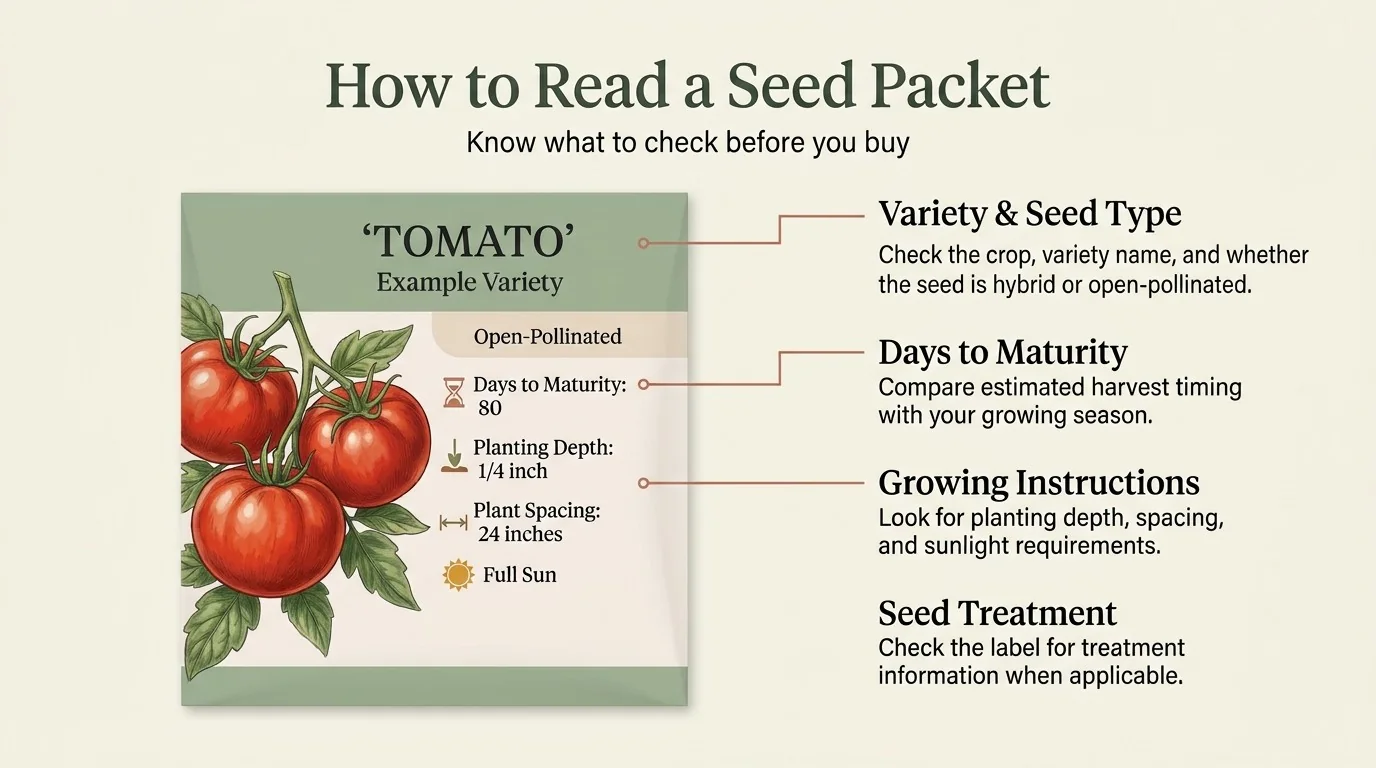
Federal seed labeling rules (the Federal Seed Act regulations in 7 CFR Part 201) apply to seed shipped across state lines. States also have their own seed laws, which can add requirements; we haven’t reviewed individual state laws here. Under the federal rules, here’s what you can expect to see on a packet of vegetable seed weighing 1 pound or less.
| Label item | When it appears | Federal rule |
|---|---|---|
| Kind and variety name (for example, “Tomato, Cherokee Purple”) | Always | 7 CFR 201.26 |
| The word “hybrid” | When the variety is hybrid seed | 7 CFR 201.26 |
| Name and address of the shipper (or an approved code plus the buyer’s name and address) | Always, for packets shipped across state lines | 7 CFR 201.27 |
| “Below Standard,” plus the germination percentage and hard seed percentage | Only when the seed tested below the federal minimum for that crop | 7 CFR 201.29 |
| “Treated with …” or “… treated” | When the seed has been treated | 7 CFR 201.31a |
| Germination percentage and test date | Not required when the seed meets the federal minimum | 7 CFR 201.29 |
That last row surprises many gardeners. Under 7 CFR 201.29, vegetable seed in containers of 1 pound or less doesn’t have to show a germination percentage or test date if it germinated at or above the federal standard for that crop. So a small packet with no germination number isn’t necessarily hiding anything. For larger containers, the rules are different: seed in containers of more than 1 pound must show the germination percentage (7 CFR 201.29a), and when germination is shown, the label must give the month and year the test was completed (7 CFR 201.30a).
Everything else on the packet, such as planting depth, spacing, days to maturity, a “packed for” year, and growing tips, is information the company chooses to add. Federal rules allow extra information as long as it isn’t misleading (7 CFR 201.25). For using that planting information, see our guide on how to start vegetable seeds indoors.
Federal Minimum Germination Standards for Common Vegetables
The federal standards in 7 CFR 201.31 set the minimum germination for vegetable seed in interstate commerce. Here are a few common crops. These are federal minimums, not predictions of what you’ll see at home, and they include hard seed. They also aren’t a germination guarantee from any seed company; a company’s own germination standards, if it publishes them, are a separate matter.
| Crop | Federal minimum germination |
|---|---|
| Bean, garden | 70% |
| Carrot | 55% |
| Cucumber | 80% |
| Lettuce | 80% |
| Onion | 70% |
| Parsley | 60% |
| Pepper | 55% |
| Spinach | 60% |
| Squash | 75% |
| Tomato | 75% |
As the table shows, the minimums differ quite a bit from crop to crop.
A Few Seed Sources to Know
The table below compares a few U.S. seed sources using only what each company or organization states on its own website or official affiliate-program profile, checked in November 2026. It isn’t a ranking, and it doesn’t include prices. “Not stated” means we didn’t find that detail in the sources we checked; it doesn’t mean the company doesn’t have or do it.
Scroll or swipe sideways to see all columns.
| Source | Type | Founded (as stated) | Location information (as stated) | Organic seed | Stated focus |
|---|---|---|---|---|---|
| True Leaf Market | Online seed company | Not stated | Not stated | Offers organic varieties | Wide selection of seed types; growing supplies |
| Park Seed | Seed company | 1868 | Began in Pennsylvania; current location not stated | Offers organic vegetable seed | 1,100+ seed varieties; seed-starting products |
| High Mowing Organic Seeds | Organic seed company | 1996 | Began in northern Vermont; trials farm in Vermont; HQ not stated | 100% certified organic | Heirloom, open-pollinated, and hybrid seed |
| Johnny’s Selected Seeds | Employee-owned seed company | 1973 | HQ: Winslow, Maine | Offers certified organic seed | Seeds, plants, tools, and supplies; own breeding and trials |
| Seed Savers Exchange | Nonprofit seed-saving group | 1975 | Founded in Missouri; seed bank in Winneshiek County, Iowa; HQ not stated | USDA organic handling certification; check each listing | Preserving and sharing heirloom and open-pollinated seed |
A few more details from the companies’ own pages:
- True Leaf Market describes its selection as including heirloom, organic, non-GMO, Asian, specialty, and cover crop garden seeds, along with growing supplies, kits, tools, and accessories.
- Johnny’s Selected Seeds says it became 100% employee-owned in 2012, that it does not knowingly sell genetically modified seed, and that its minimum germination requirements exceed Federal Seed Act minimums.
- High Mowing Organic Seeds says it began with 28 varieties, many from its founder’s backyard, and that all its seed is certified organic and non-GMO. Its varieties include vegetable, fruit, herb, and flower seed.
- Park Seed says its business began in the Pennsylvania kitchen of a 15-year-old, and it lists heirloom flowers and organic vegetables among its offerings.
- Seed Savers Exchange says its seed bank at Heritage Farm holds about 20,000 varieties. It also says it is certified under USDA organic regulations for handling (extracting, storing, packaging, labeling, and distributing) organic vegetable and flower seeds. That certification covers how it handles its organic seed; on its own, it doesn’t tell you that every variety it offers is organic, so check whether a listing is labeled organic.
Other well-known seed companies weren’t included because we couldn’t check their details in the same way when we reviewed sources. Before you order from any company, check its shipping policy for your state, what it offers in the crops you want, and how it describes its seed treatment and organic status.
Before You Buy: Check Last Year’s Seeds
Before you place a new order, sort through the seed you already have. University of Vermont Extension suggests a simple germination test:
- Wet a paper towel, wring it out, and lay about 10 seeds in a row near one edge.
- Fold the towel over the seeds, place it in a sealable plastic bag, and label it with the date and the crop.
- Keep the bag somewhere warm and check that the towel stays damp.
- On or after the expected germination date (the packet usually lists days to germination), count how many sprouted.
If fewer than half germinated, UVM suggests buying new seed. If most sprouted, the seed is still worth planting; you may just want to sow a little more thickly. UMN Extension, quoted in our seed-starting guide, recommends sowing two or more seeds per cell when using older seed with lower germination.
How you store seed matters, too. UVM recommends a cool, dark, dry place, such as a sealed glass jar or metal container, and notes that temperatures around 40°F are best. If you keep seed in the refrigerator, use an airtight container to keep out humidity.
Frequently Asked Questions
Are hybrid seeds the same as GMO seeds?
No. WSU Extension describes hybrids as the result of controlled pollination between two different varieties, while genetically modified (GMO or GE) seeds have had their DNA altered by human manipulation, often by inserting genes from unrelated species. WSU also notes that GMO seeds are rarely available to home gardeners.
Can I save seeds from hybrid plants?
You can, but the plants that grow from saved F1 seed may not have the same traits as the parent plant, and they can differ from one another. University of Arizona Cooperative Extension explains that an F1 hybrid’s traits separate in the next generation, so the same characteristics aren’t reliably reproduced. If you want to save seed that comes true, grow open-pollinated or heirloom varieties and keep different varieties of the same crop from cross-pollinating.
Why are some seeds pink or blue?
Bright coloring usually means the seed has been treated, often to protect it from seed- or soil-borne diseases. Federal rules require treated seed to be labeled with the treatment, so check the packet.
Does a seed packet have to list the germination rate?
Not always. Under federal rules, small packets (1 pound or less) that meet the federal minimum germination standard don’t have to show a germination percentage or test date. Packets that test below the standard must say “Below Standard” and show the germination percentage. State laws may add requirements.
How long do vegetable seeds last?
It depends on the crop and storage. University of Vermont Extension says tomato and kale seeds are usually viable for about four years, and corn and pepper seeds for about two, though that varies. A quick paper-towel germination test is the easiest way to check.
Getting Started
Make a short list of the crops you want to grow and how many plants you have room for, then check your leftover seed. Decide which labels matter to you, such as certified organic, untreated, or open-pollinated, and look for sellers whose catalogs describe varieties clearly for your region.
When your seeds arrive, our seed-starting calendar will help you time indoor sowing, and our guide to seed-starting supplies covers what you need to get them growing.
Sources
- Electronic Code of Federal Regulations (eCFR), Title 7, Part 201 (Federal Seed Act regulations): § 201.25, § 201.26, § 201.27, § 201.29, § 201.29a, § 201.30a, § 201.31, § 201.31a
- eCFR, Title 7, Part 205 (National Organic Program): § 205.204 Seeds and planting stock practice standard
- Washington State University Extension, Yakima County: Confusing Seed Terms
- Clemson Cooperative Extension, Savannah Valley District: Understanding the Seed Catalog
- University of Vermont Extension: Can old seeds still grow?
- True Leaf Market: official affiliate program profile (Awin)
- Park Seed: official affiliate program profile (Awin)
- High Mowing Organic Seeds: History and Philosophy, home page
- Johnny’s Selected Seeds: About, History, Ownership, About Our Seed
- University of Arizona Cooperative Extension, Yavapai County (Backyard Gardener): Heirloom vs. Hybrid
- Seed Savers Exchange: About, Organic Certifications