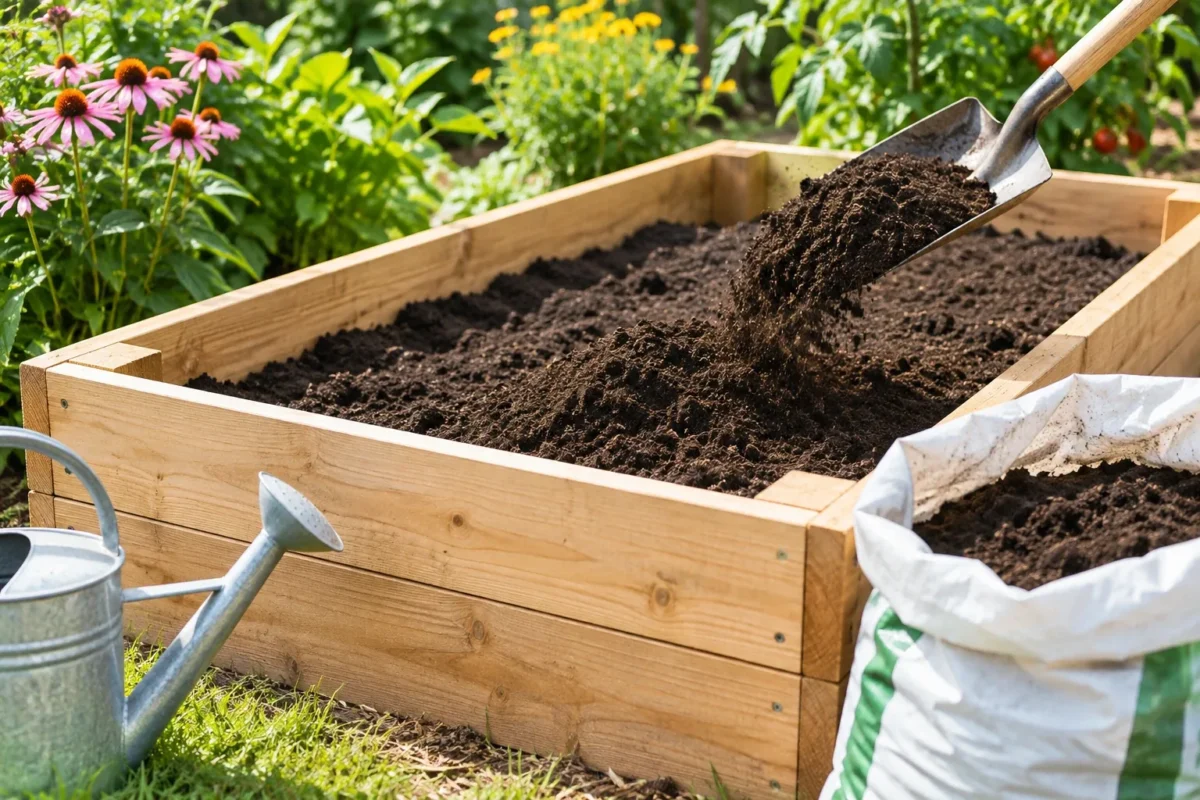
A 4 × 8 foot raised bed filled 12 inches deep holds 32 cubic feet of soil, which is about 1.2 cubic yards. If you’re buying bags, divide 32 by the volume printed on the bag and round up: bags labeled 1.5 cubic feet would take 22 bags, and bags labeled 2 cubic feet would take 16.
That’s the answer for one popular size. The rest of this guide shows you how to get the same answer for your own bed, gives you a chart for 7 common sizes at 5 depths, and explains what to fill the bed with, ways to need less soil, and how to keep the soil level up in later seasons.
One rule before you measure: calculate with the inside dimensions of the bed and the depth of soil you’ll actually put in, not the outside of the frame or the height of the boards. Board thickness takes up space, and if you plan to leave a gap below the top edge, that space won’t hold soil.
The Quick Answer: A 4 × 8 Raised Bed
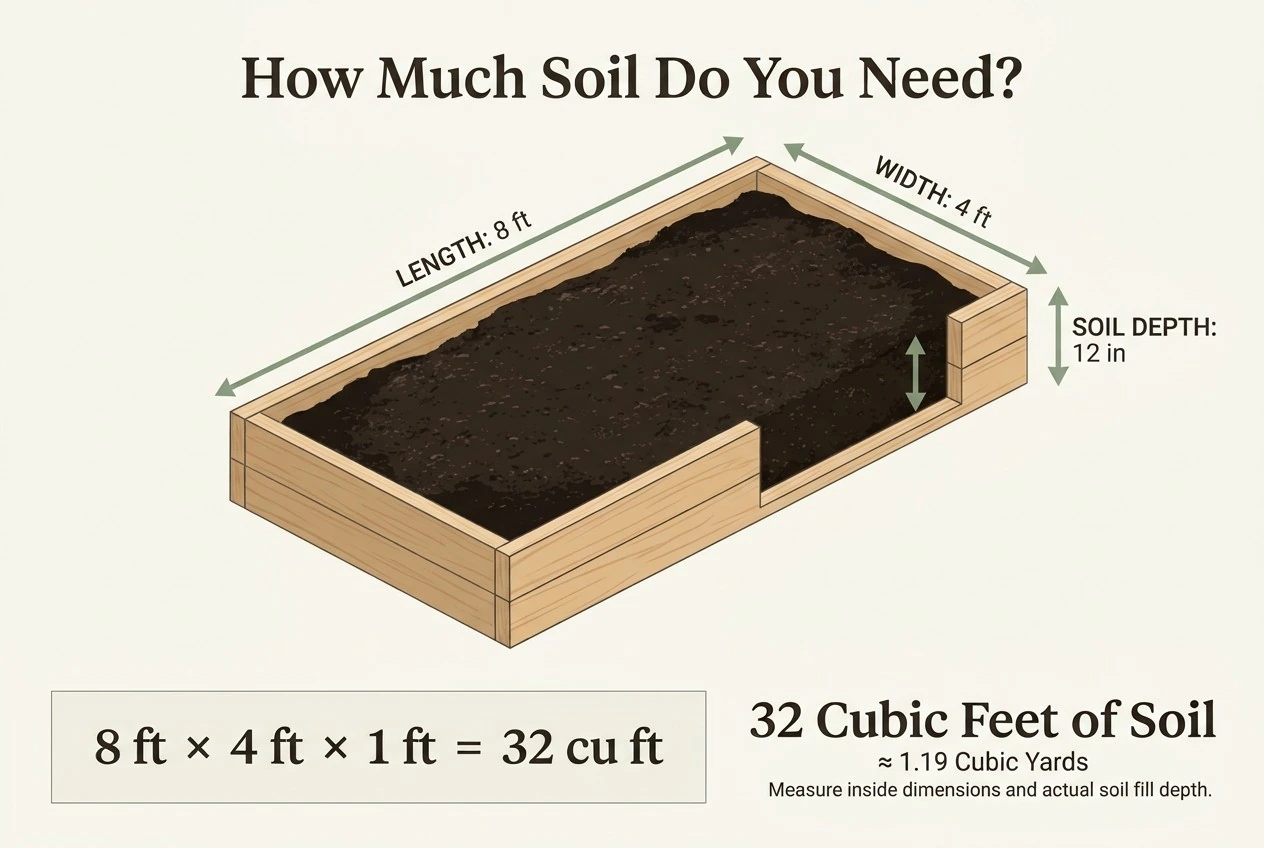
Here’s the math for a 4 × 8 foot bed (inside measurements) filled 12 inches deep:
- Volume in cubic feet: 4 ft × 8 ft × 1 ft = 32 cubic feet
- Cubic yards (for bulk orders): 32 ÷ 27 = about 1.19 cubic yards
- Bags: 32 ÷ the bag’s labeled volume, rounded up
- Labeled 1 cubic foot: 32 bags
- Labeled 1.5 cubic feet: 21.3, rounded up to 22 bags
- Labeled 2 cubic feet: 16 bags
Bag sizes vary by product and store, so these are examples rather than a standard. Use the volume printed on the bags you’re actually buying.
The Formula: Length × Width × Depth
You can work out any rectangular bed with one formula:
Length (ft) × Width (ft) × Depth (in) ÷ 12 = cubic feet of soil
Step by step:
- Measure the inside length and width in feet. If a measurement includes inches, divide the inches by 12 and add them to the feet (3 feet 6 inches is 3.5 feet).
- Decide on your fill depth in inches. This is the depth of soil you’ll actually add, measured on the inside of the bed.
- Multiply length × width × depth, then divide by 12. That gives you cubic feet.
- For bulk soil, divide cubic feet by 27 to get cubic yards, because 1 cubic yard is 3 ft × 3 ft × 3 ft = 27 cubic feet.
- For bags, divide cubic feet by the volume on the bag and round up. You can’t buy part of a bag.
If the bag lists quarts or liters instead of cubic feet: 1 cubic foot is about 25.7 dry quarts or about 28.3 liters. Divide the bag’s quarts by 25.7, or its liters by 28.3, to get its volume in cubic feet. Then use step 5.
Beds that aren’t one simple rectangle: split an L-shaped bed into two rectangles, work out each one, and add them together.
Raised Bed Soil Chart for 7 Common Sizes
The chart below covers 7 common bed sizes at 5 fill depths, for 35 combinations in all. Sizes are inside measurements. Depth is the depth of soil you add. These numbers are straight calculations from the formula above, not recommendations for how deep your bed should be.
On mobile, swipe sideways to view all columns.
| Inside size | 6 in deep | 8 in deep | 11 in deep | 12 in deep | 18 in deep |
|---|---|---|---|---|---|
| 2 × 4 ft | 4.0 cu ft (0.15 cu yd) | 5.3 cu ft (0.20 cu yd) | 7.3 cu ft (0.27 cu yd) | 8.0 cu ft (0.30 cu yd) | 12.0 cu ft (0.44 cu yd) |
| 4 × 4 ft | 8.0 cu ft (0.30 cu yd) | 10.7 cu ft (0.40 cu yd) | 14.7 cu ft (0.54 cu yd) | 16.0 cu ft (0.59 cu yd) | 24.0 cu ft (0.89 cu yd) |
| 3 × 6 ft | 9.0 cu ft (0.33 cu yd) | 12.0 cu ft (0.44 cu yd) | 16.5 cu ft (0.61 cu yd) | 18.0 cu ft (0.67 cu yd) | 27.0 cu ft (1.00 cu yd) |
| 2 × 8 ft | 8.0 cu ft (0.30 cu yd) | 10.7 cu ft (0.40 cu yd) | 14.7 cu ft (0.54 cu yd) | 16.0 cu ft (0.59 cu yd) | 24.0 cu ft (0.89 cu yd) |
| 3 × 8 ft | 12.0 cu ft (0.44 cu yd) | 16.0 cu ft (0.59 cu yd) | 22.0 cu ft (0.81 cu yd) | 24.0 cu ft (0.89 cu yd) | 36.0 cu ft (1.33 cu yd) |
| 4 × 8 ft | 16.0 cu ft (0.59 cu yd) | 21.3 cu ft (0.79 cu yd) | 29.3 cu ft (1.09 cu yd) | 32.0 cu ft (1.19 cu yd) | 48.0 cu ft (1.78 cu yd) |
| 4 × 12 ft | 24.0 cu ft (0.89 cu yd) | 32.0 cu ft (1.19 cu yd) | 44.0 cu ft (1.63 cu yd) | 48.0 cu ft (1.78 cu yd) | 72.0 cu ft (2.67 cu yd) |
How to read it: find your bed’s inside size in the left column, then move across to your fill depth. To turn a cubic-foot figure into bags, divide by the volume on your bags and round up. For a 3 × 8 foot bed filled 8 inches deep, for example, 16.0 cubic feet ÷ 2 cubic feet per bag = 8 bags.
Beds on the ground vs. planters with a closed bottom: the volume math is the same for both. What the depth means for your plants isn’t, as the next section explains.
About the 11-inch column: it’s there for beds whose inside height works out to about 11 inches, which some two-board frames do. Board sizes vary, so measure your own frame rather than relying on the label on the lumber.
Rounding: cubic yards are rounded to two decimal places. Suppliers who sell bulk soil may sell it in set increments, so check how they measure before you order.
How Deep Should the Soil Be?
Everything above is math. From here on, growing advice is credited to the university Extension source it comes from. Practical tips about buying and moving soil are labeled as general tips.
- What OSU’s “about 8 inches” refers to. Oregon State University (OSU) Extension describes building an unframed raised bed by loosening the native soil, working in organic matter, and shaping the beds. It says this creates a soil-and-organic mix about 8 inches deep, “sufficient for adequate rooting of most vegetable plants”. That figure describes the amended layer in a bed built directly on the ground. It isn’t the total depth of soil the roots can use, because the native ground is still underneath.
- You can loosen the ground underneath. If your frame sits on top of native soil, OSU suggests digging down or rototilling at least 6 inches and mixing that native soil into the soil mix as you fill. It calls this optional, but notes that it loosens the soil for deeper root growth.
- A planter with a closed bottom is a different case. Everything in this section is about beds that sit on the ground. In a raised planter or container with a solid bottom, the fill you add is all the soil the roots have, so OSU’s 8-inch figure doesn’t carry over. Follow the planter maker’s guidance for those. The volume math in the chart works the same either way.
- Deep or long beds need a stronger frame. OSU recommends reinforcing beds that are longer than 6 feet or taller than about 18 inches, with cross cable, anchored stakes, or similar supports, so the weight of the soil doesn’t push the boards outward.
Our raised bed gardening guide for beginners covers sizing, sunlight, and safe building materials in more detail.
Bags vs. Bulk: How to Decide
Raised beds take more soil than many people expect. OSU Extension notes that substantial quantities are needed, so the soil or organic matter should be readily available and relatively inexpensive. It lists two common sources: native soil moved from other parts of your garden, and bulk soil mixes from garden centers or landscape supply companies.
A few things to weigh:
- How much you need. Use the chart. For a sense of scale, OSU notes that 1 cubic yard covers 162 square feet at 2 inches deep. That’s the same 27 cubic feet, spread thin.
- Getting it home and into the bed (general tip). Bags can be carried a few at a time and stacked until you’re ready. A bulk delivery is a single pile, so plan where it will go and how you’ll move it into the bed.
- What’s in the mix. OSU advises choosing a mix made for the job: good landscape suppliers offer separate mixes for different uses, and a coarser soil that works for a lawn may not suit a raised vegetable bed. Whichever way you buy, read the label or ask the supplier what the mix contains.
- Ordering the right amount (general tip). Ask how the supplier measures bulk soil. If it’s sold by the cubic yard, divide your cubic-foot total by 27. For bags, round up to a whole bag.
What to Fill It With (the Short Version)
OSU Extension’s advice is to purchase or prepare a soil mix with high organic matter, and it recommends a soil test so you can adjust nutrients if needed. If you’re blending your own fill, our raised bed guide walks through how much organic matter to aim for and the compost-to-soil ratios to use. To make compost of your own, see our composting guide for beginners.
The volume math doesn’t change with the recipe. Whatever goes into the bed, the parts have to add up to the cubic feet you calculated. To split a total by a recipe, divide it by the number of parts. For example, a 32-cubic-foot bed and a recipe of 3 parts of one ingredient to 1 part of another works out to 24 and 8 cubic feet. That example only shows the arithmetic; it isn’t a recommended mix.
Ways to Need Less Soil (and Their Trade-offs)
If the number in the chart is more than you want to buy, these are the options backed by Extension sources, plus one popular idea that isn’t.
- Fill to a shallower depth (beds on the ground). Going from 12 inches to 8 inches in a 4 × 8 bed cuts the fill from 32 to about 21.3 cubic feet. In OSU’s method, the 8-inch mix sits on loosened native soil that roots can also grow into, so a shallower fill makes the most sense when the bed is open to the ground. It isn’t a guide for planters with closed bottoms.
- Work the native soil underneath. OSU’s optional step of loosening the ground below the frame and mixing it in lets roots grow down into soil you already have.
- Skip the frame. OSU describes unframed beds, where soil and organic matter are mounded and shaped, as another way to build a raised bed. Washington State University (WSU) Extension also points to soil mounds as a practical option.
- Be cautious about filling the bottom with logs and branches (hügelkultur). This method buries woody debris under the soil. WSU Extension notes that there are no peer-reviewed scientific studies on hügelkultur, and that the mounds collapse as the wood breaks down, so the beds have to be rebuilt. WSU suggests following raised bed principles that are backed by research, and using woody material on the soil surface as mulch instead.
Topping Up in Later Seasons
A raised bed isn’t a one-time fill. University of Illinois Extension notes that settling soil is a normal part of raised bed gardening. Newly installed fill has little soil structure, and the gardener’s frequent digging and disturbance add to the settling.
Illinois Extension’s advice for keeping up:
- Top-dress every year with a few inches of compost or high-quality topsoil. It says this should be enough to keep up with the settling soil level.
- Avoid tilling an established bed, which can destroy the developing soil structure and speed up settling.
- Consider an off-season cover crop. Roots in the soil help build structure. It won’t stop settling, but it slows it.
- Combine mulch with topdressing to help suppress weed seeds.
OSU Extension likewise recommends composting raised beds regularly.
To work out how much to add, use the same formula with the depth you’re topping up. For a 4 × 8 bed, each inch of top-dressing is 4 × 8 × 1 ÷ 12 = about 2.7 cubic feet. Measure how far the soil sits below where you want it, and use that depth.
Frequently Asked Questions
How many bags of soil do I need for a 4×8 raised bed?
It depends on the fill depth and the volume on the bag. At 12 inches deep, a 4 × 8 bed holds 32 cubic feet, which works out to 22 bags labeled 1.5 cubic feet or 16 bags labeled 2 cubic feet. At 8 inches deep, it’s about 21.3 cubic feet: 15 bags labeled 1.5 cubic feet or 11 bags labeled 2 cubic feet. Always round up to a whole bag.
How many cubic yards of soil do I need for a raised bed?
Work out the cubic feet (length × width in feet × depth in inches ÷ 12), then divide by 27. A 4 × 8 bed filled 12 inches deep needs about 1.19 cubic yards. A 4 × 12 bed at the same depth needs about 1.78 cubic yards.
Can I use only topsoil?
OSU Extension recommends a soil mix with high organic matter rather than soil alone. Our raised bed guide, linked above, explains how much organic matter to aim for and how to blend compost into the fill.
Should I fill the bottom with logs or branches?
WSU Extension notes that there are no peer-reviewed studies on hügelkultur and that buried wood breaks down, so beds built this way collapse and need rebuilding. It suggests using woody material as mulch on the soil surface instead.
Getting Started
Measure the inside of your bed, decide how deep you’ll fill it, and run the numbers, or find your size in the chart. Check the volume on the bags or ask your supplier how bulk soil is sold, then round up. Plan to top the bed up each year as the soil settles.
If you haven’t built the bed yet, start with our beginner’s guide to raised bed gardening. If you’re still deciding between a raised bed and planting in the ground, our guide to starting a vegetable garden from scratch covers in-ground beds.
Sources
- Oregon State University Extension: Raised Bed Gardening (FS 270)
- Washington State University Extension: Hügelkultur: What Is It, and Should It Be Used in Home Gardens?
- University of Illinois Extension: Refreshing raised bed soil generates exceptional results