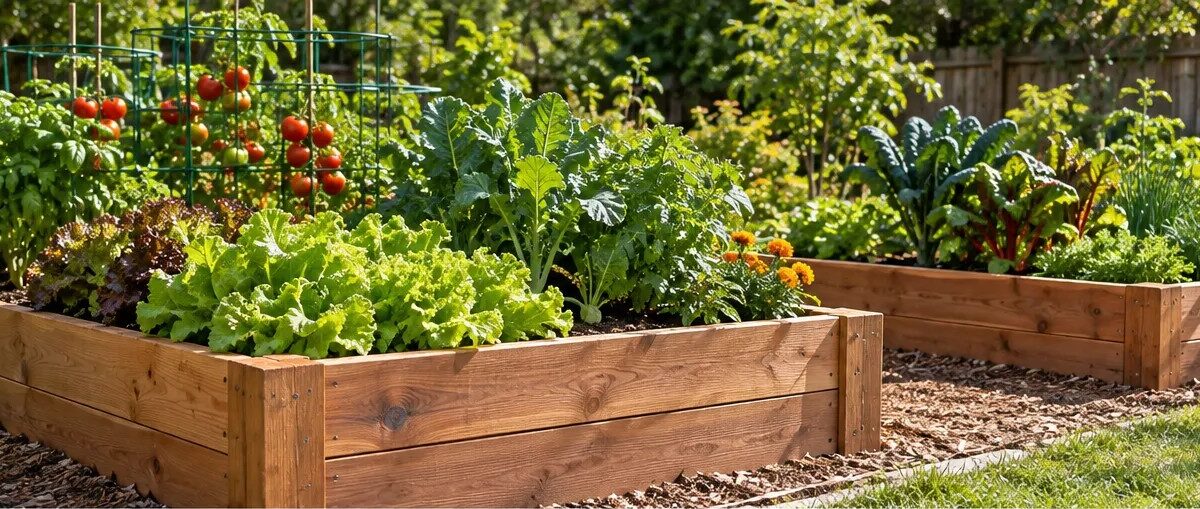
If you’ve read our beginner’s guide to starting a vegetable garden, you already know that success starts with the basics: good light, workable soil, and a plan you can actually stick to. A raised bed is one of the simplest ways to get all three at once, especially if your yard’s native soil is compacted, rocky, or just not something you want to dig into by hand. Here’s what a raised bed actually gives you, where to put it, how to size it, what to build it out of, and how to fill it — based on what university Extension programs have actually tested and documented, not general internet wisdom.
What a Raised Bed Actually Gives You (and What It Costs You)
Raised beds are essentially a contained, elevated growing area you build on top of your existing ground. According to Oregon State University Extension, the technique is “a viable solution to the problems of poor soil conditions,” and beds filled with a high-quality soil mix are “a good alternative for sites with heavy metal or other soil contamination” — useful if you don’t fully trust what’s underneath your lawn. Because the soil in a raised bed sits above grade and drains independently of the ground below it, it also warms up and dries out earlier in spring, which OSU notes leads to “faster warming of the soil and more rapid growth in the early season.”
University of Maryland Extension lists the practical upsides in similar terms: raised beds warm up quickly in spring, drain well, increase the available rooting area, and — because you never step into the planting area — reduce soil compaction and erosion, which in turn supports greater yields per square foot.
None of that is free, though. UMD is just as direct about the trade-offs: raised beds mean real up-front labor and expense, they dry out quickly in hot, dry weather (since they’re elevated and well-drained), they’re relatively permanent once built, you have to plan your garden around the bed’s fixed dimensions, and — unless you terrace them — they don’t work well on a slope. Worth knowing before you start buying lumber.
Choosing the Right Spot
Before you decide on a size or a material, the location matters more than either. University of Minnesota Extension is specific about this: for full-sun crops like tomatoes, peppers, and eggplants, you should “locate your raised bed in an area that receives at least 6 to 8 hours of sunlight each day.” That guidance is tied to those particular crops, not a blanket rule for every raised bed — it’s the benchmark for the plants that actually need full sun to produce well.
If your only available spot gets less light than that, you’re not out of options. UMN notes that a bed receiving only a few hours of sunlight (part to full shade) can still support crops like lettuce, baby kale, scallions, microgreens, radishes, and beet greens — all plants that tolerate lower light levels reasonably well. It’s a genuinely different plant list than a full-sun bed, so it’s worth deciding early which category your site falls into, rather than assuming the crops from a seed catalog cover page will work wherever you happen to have room.
Sizing Your Bed
For a framed bed — sides built from wood, stone, or another material — UMD Extension gives a general range of 2 to 4 feet wide and 2 to 12 inches high. Width matters more than it might seem: OSU Extension puts a firmer number on it, recommending “a maximum width of 4 feet” as “a good choice for adult gardeners,” specifically so you can reach the center of the bed from either side without ever stepping into the growing area. That’s not just a comfort detail — it’s what protects the soil-compaction benefit that’s one of the main reasons to build a raised bed in the first place.
If you skip the frame entirely and simply mound and amend the soil, OSU notes that an unframed bed typically creates “a soil-and-organic mix about 8 inches deep, sufficient for adequate rooting of most vegetable plants” — a useful reference point if you’re deciding how deep to build even a framed bed.
Length and height come with one more rule worth remembering before you build: OSU Extension states that beds “longer than 6 feet or taller than about 18 inches should be reinforced (with cross cable, anchored stakes, or other mechanisms) to help prevent the weight of the soil from pushing the boards outwards.” Damp soil is heavier than it looks, and a long or tall bed without reinforcement can bow outward over time.
What to Build It With — Wood Safety
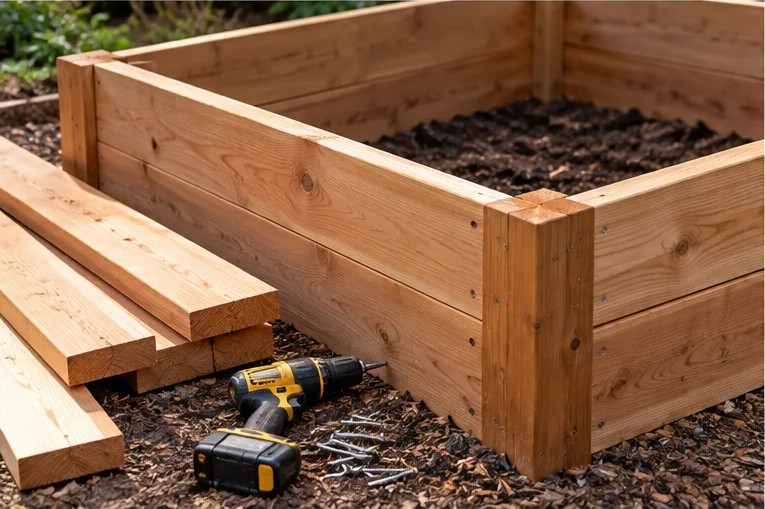
UMD Extension lists several workable materials for the bed’s frame: stone, brick, concrete blocks, wood boards (oak, locust, poplar, and cedar are named specifically), and rigid recycled-plastic boards — or you can skip a hard frame altogether and build sloped, unframed sides.
Wood is the most common choice, and it’s also where the most confusion shows up. If you’re using pressure-treated lumber, UMD Extension is specific about what’s currently on the market: “Micronized Copper Azole (MCA) is currently the most widely available type of wood preservative for residential use. It does not contain arsenic, but it does contain copper,” and UMD describes it as low in toxicity — not “safe” in an unqualified sense, but low-toxicity within the range UMD is evaluating. That’s a meaningfully different, and older, chemistry than what it replaced: “An older type of wood preservative called Chromated Copper Arsenate (CCA) contained arsenic, copper, and chromium. CCA-treated wood is no longer available for residential use as of 2004.” UMD’s guidance is direct on this point: “Avoid using older types of wood treatments such as CCA, creosote, and Penta-treated lumber.” If you’re building with reclaimed or older lumber rather than new stock, this is the thing to check before it goes anywhere near a vegetable bed.
Concrete blocks carry their own, different caveat. UMD notes that fly ash is often included in the mix used to make them, and “fly ash is a byproduct of burning coal and so contains heavy metals and other hazardous waste.” That’s not a blanket case against using concrete block — it’s a specific, traceable concern about one ingredient. If it’s something you’d rather not risk, UMD’s own suggestion is to seal the blocks with a polymer paint or choose a different material for the frame instead.
Filling It: Soil and Organic Matter
Once the frame is up, what you put inside it matters as much as the frame itself. UMD Extension recommends that the organic matter content in a raised bed’s soil “should be 25%-50% by volume” — plain garden soil straight from a bag typically won’t get you there on its own.
For actually mixing that fill, UMD outlines a couple of workable approaches: combining compost and purchased topsoil in a 1:2 or 1:1 ratio, or, for a lighter mix, combining compost with a soilless growing mix at a 1:1 ratio. Either approach gets you into that 25%–50% organic matter range without having to test and calculate it yourself.
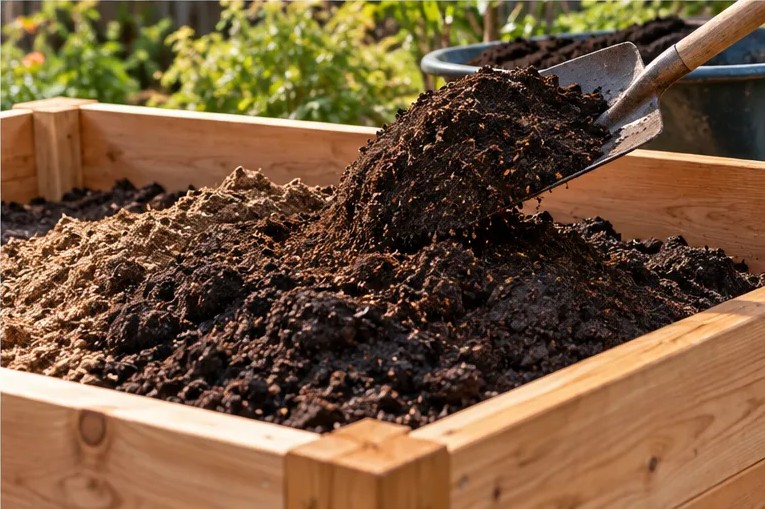
You don’t need to worry that the native soil under the bed goes to waste, either. UMD notes that plant roots grow down through the decomposing turf and weeds into the soil below, and that “over time the quality of the native soil below the raised bed will be improved through the addition of organic matter and root growth of crop plants.” A raised bed isn’t sealed off from the ground beneath it — it’s slowly improving it.
Common Mistakes First-Time Raised Bed Gardeners Make
- Building it wider than you can reach. Going past the roughly 4-foot width OSU recommends means you’ll eventually have to step into the bed to reach the middle — undoing the compaction benefit that’s a big part of the point of raising it in the first place.
- Skimping on soil depth. OSU’s reference point of about 8 inches of soil-and-organic mix is what’s “sufficient for adequate rooting of most vegetable plants” — a shallower fill leaves roots more cramped than they need to be.
- Building with old CCA, creosote, or Penta-treated lumber. UMD Extension’s guidance is explicit about avoiding these older wood treatments specifically — it’s an easy mistake if you’re using reclaimed wood without checking what it was treated with.
- Skipping reinforcement on long or tall beds. Past 6 feet long or about 18 inches tall, OSU recommends reinforcing the frame with cross cables or anchored stakes so the weight of damp soil doesn’t bow the sides outward.
- Filling with plain topsoil instead of an organic-matter-rich mix. Without getting into UMD’s recommended 25%–50% organic matter range — using compost blended with topsoil or a soilless mix, rather than topsoil alone — the bed won’t perform as well as its drainage and warmth advantages promise.
Get the site, the size, the material, and the fill right, and a raised bed is mostly a one-time project: build it once, and you’re mainly just topping up compost and organic matter each season after that.