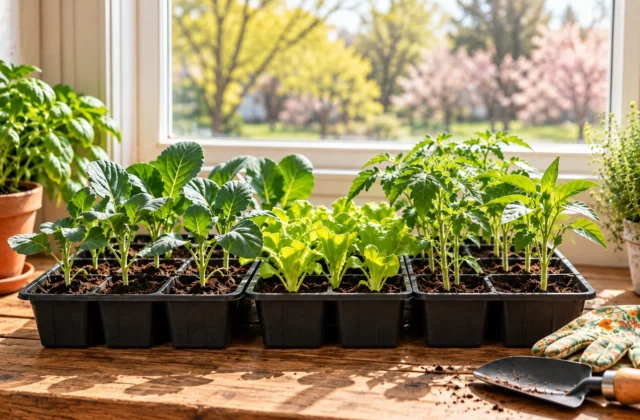
If your seedlings shot up tall and thin, leaned hard toward the window, and then flopped over, you’re in good company. University of Minnesota Extension puts it plainly: “Lack of light is the major cause of elongated, skinny stems.”
The fix is usually an electric light, but shopping for one can be confusing. Packages list watts, lumens, colors, and sometimes numbers like PPF or PPFD, and the advice on how close to hang the light seems to change from one source to the next.
This guide explains what seedlings actually need from a light, which types of fixtures work, what to compare on the box or spec sheet, and how to set everything up. Where university Extension sources give different numbers, we show each one and explain why they differ, rather than pretending there’s a single right answer.
For the full seed-starting process, from containers and mix to hardening off, see our guide on how to start vegetable seeds indoors.
Do You Really Need a Grow Light?
For most vegetable seedlings started in late winter, yes, or at least you’ll get sturdier plants with one.
Why a Sunny Window Usually Falls Short
Iowa State University Extension notes that “even the brightest windowsill only has a fraction of the light intensity of any outdoor location,” and that indoor light is especially low in winter because of short days, a low sun angle, and frequent overcast weather.
That’s exactly when many vegetables are started indoors. University of Minnesota Extension adds that spring sunlight “is relatively weak compared to artificial light sources kept close to the plants,” and that windowsills can be the coldest spot in the house at night and the hottest during the day.
A south-facing window can work for a handful of plants, according to the same UMN guide. If you’re starting a few trays, though, a light is the more reliable choice.
Signs Your Seedlings Need More Light
- Tall, thin stems with lots of space between leaves
- Seedlings leaning or bending toward a window
- Weak stems that topple over once the seedlings are a few inches tall (Clemson HGIC)
- Pale or yellowing leaves along with stretching (Iowa State lists stretching, spindly growth, and yellowing foliage as signs that light intensity should be increased)
Too much light has its own signs. Iowa State lists leaf scorch, bleached leaves, and extremely compact growth as reasons to move a fixture farther away or reduce its output.
What Seedlings Need From a Light
A seed-starting light has three jobs: deliver enough light, for enough hours, with a dark break each night.
Enough Light at the Leaves
Light gets weaker quickly as it spreads out from a fixture. Iowa State explains that the amount of usable light reaching the plant “drops off sharply as you get further away from the fixture.” That’s why every source below talks about distance, and why seedlings can still stretch under a light that hangs too high.
How close “close enough” is depends on the type of light. We’ll cover that in the setup section.
Hours of Light per Day
University Extension guides agree on the general idea but not on an exact number:
| Source | Recommended hours of light per day |
|---|---|
| University of Minnesota Extension | 12 to 16 |
| Iowa State University Extension | 12 to 14 (fluorescent shop fixture) |
| NDSU Extension | About 16 |
| UW–Madison Extension | About 16 for most crops |
| Clemson HGIC | 16 to 18 |
A practical starting point is the overlap: around 14 to 16 hours. Light intensity and hours work together. Iowa State notes that more hours raise the total daily light, so a dimmer setup benefits from the higher end (see the DLI section below).
One crop-specific exception is worth knowing. UW–Madison Extension advises giving spinach no more than 10 or 11 hours, because longer days can trigger bolting, which makes the leaves “tough and bitter tasting.”
A Dark Period Every Night
More hours isn’t always better. UMN Extension says, “Don’t leave the lights on continuously, as many plants need some dark period each night to develop properly.” Iowa State’s general guidance for home gardeners is to keep lights on no more than 16 hours a day. A plug-in timer is the easiest way to keep a steady schedule.
Types of Lights for Seed Starting
You don’t need specialty equipment. Iowa State Extension calls a plug-in shop fluorescent or LED fixture “the perfect type of light to use for seed starting” for most home gardeners.
LED Shop Lights
LED fixtures have become the go-to choice for many home gardeners. According to Iowa State, LEDs are efficient, run cooler than fluorescent fixtures, last a long time, and don’t fade over time the way fluorescent tubes do.
For LED shop lights, Iowa State recommends full-spectrum fixtures with high light output. Look for “full spectrum” or “daylight” on the package.
Fluorescent Shop Lights
Fluorescent tubes were the standard seed-starting light for years and still work. UMN Extension says standard fixtures with two “cool white” tubes “give plants adequate light and are inexpensive,” and that mixing cool white and natural daylight tubes gives good light that’s also more pleasant to look at.
The catch is upkeep. Iowa State notes that fluorescent bulbs “dim over time and should be replaced every one to two years.” It also notes that T5 tubes are more efficient than the older T8 and T12 sizes, and that the sizes aren’t interchangeable within the same fixture.
LED Grow Lights (Bars, Strips, and Panels)
Fixtures sold as grow lights are designed to emit the red and blue wavelengths plants use most. That’s why many have a pink or purple glow. Iowa State’s view is that grow lights “can be a good source of light for seedlings but are often more expensive and not necessary,” because a full-spectrum bulb provides enough red and blue light for seedlings at a lower cost.
One advantage of products made as grow lights is better documentation. Iowa State notes that grow lights often list their PPF, a plant-specific measure of light output that ordinary shop lights rarely provide.
What to Skip: Incandescent Bulbs
Ordinary incandescent bulbs are a poor fit. NDSU Extension notes that they “generate a lot of heat” and that their light “is not in the correct light range needed for plant growth.”
What to Look For on the Box or Spec Sheet
Without brand recommendations, the most useful thing you can do is compare the right numbers. Here’s what each common label tells you, based on Iowa State’s guide to light measurements:
| On the label | What it tells you | How to use it |
|---|---|---|
| Watts | How much electricity the fixture uses | Useful for running costs, not for brightness. Watts “are not a reliable indication of light intensity.” |
| Lumens | How bright the light looks to people | Better than watts for comparing shop lights, but it doesn’t measure the light plants use. |
| PPF (µmol/s) | Total plant-usable light the fixture emits | The best number for comparing two grow lights. Often listed only for products sold as grow lights. |
| PPFD (µmol/m²/s) | Plant-usable light that reaches a surface | Depends on distance, so it’s only meaningful with the hanging height it was measured at. |
| Color: “full spectrum,” “daylight,” or Kelvin (K) | The approximate color of the light | Lower K is redder; higher K is bluer. Iowa State suggests “full spectrum” or a mid-range Kelvin value, or mixing warm and cool tubes. |
A few practical features matter as much as the numbers:
- Size that matches your trays. Choose a fixture long enough to sit over all of your trays. Because usable light drops off quickly with distance from the fixture, seedlings that aren’t directly under it get less light.
- Adjustable height. You’ll raise the light as seedlings grow. Hanging chains or an adjustable shelf make that easy. UMN suggests hanging lights from chains for this reason.
- A plug that works with a timer. A simple plug-in timer, as UMN suggests, turns the lights on and off automatically.
- Heat. Cooler-running fixtures can sit closer to plants without damaging them.
- The maker’s recommended hanging height. This is especially important for LEDs, which vary widely in output.
A Quick Guide to PPFD and DLI
You don’t need a light meter to grow good seedlings. If you’re comparing grow lights that list PPF or PPFD, though, one formula helps.
Daily light integral (DLI) is the total amount of plant-usable light that reaches an area in one day. Iowa State Extension gives this formula:
DLI = PPFD × hours the light is on × 0.0036
- PPFD is in micromoles per square meter per second (µmol/m²/s).
- Hours is the number of hours per day the light is on.
- DLI comes out in moles per square meter per day (mol/m²/day).
- 0.0036 converts units: 3,600 seconds in an hour, divided by 1,000,000 micromoles in a mole.
The formula assumes the PPFD is measured at leaf height and stays steady while the light is on. That’s a reasonable assumption under an electric light in a room without much daylight. It only counts the light from the fixture, and if the PPFD varies across your trays, an average from several spots gives a better picture. A worksheet from UNH Cooperative Extension uses the same 0.0036 factor and notes that the lamp reading should be taken at the height of the plants.
How much do seedlings need? Iowa State’s general table places “starting seedlings” at the high end of its 6 to 10 mol/m²/day range and the low end of its 12 to 16 range. That works out to roughly 10 to 12 mol/m²/day. For comparison, a 2021 North Carolina State University study on tomato seedlings described 13.0 mol/m²/day as a commercial standard.
Example: If a grow light’s spec sheet lists an average PPFD of 200 µmol/m²/s at your planned hanging height, and you run it 16 hours a day:
200 × 16 × 0.0036 = about 11.5 mol/m²/day
That lands in Iowa State’s seedling range. Treat these numbers as a way to compare fixtures, not as exact targets. Needs vary by crop, and the PPFD you get depends on the actual hanging height.
How to Set Up a Seed-Starting Light
Start Close, and Raise the Light as Seedlings Grow
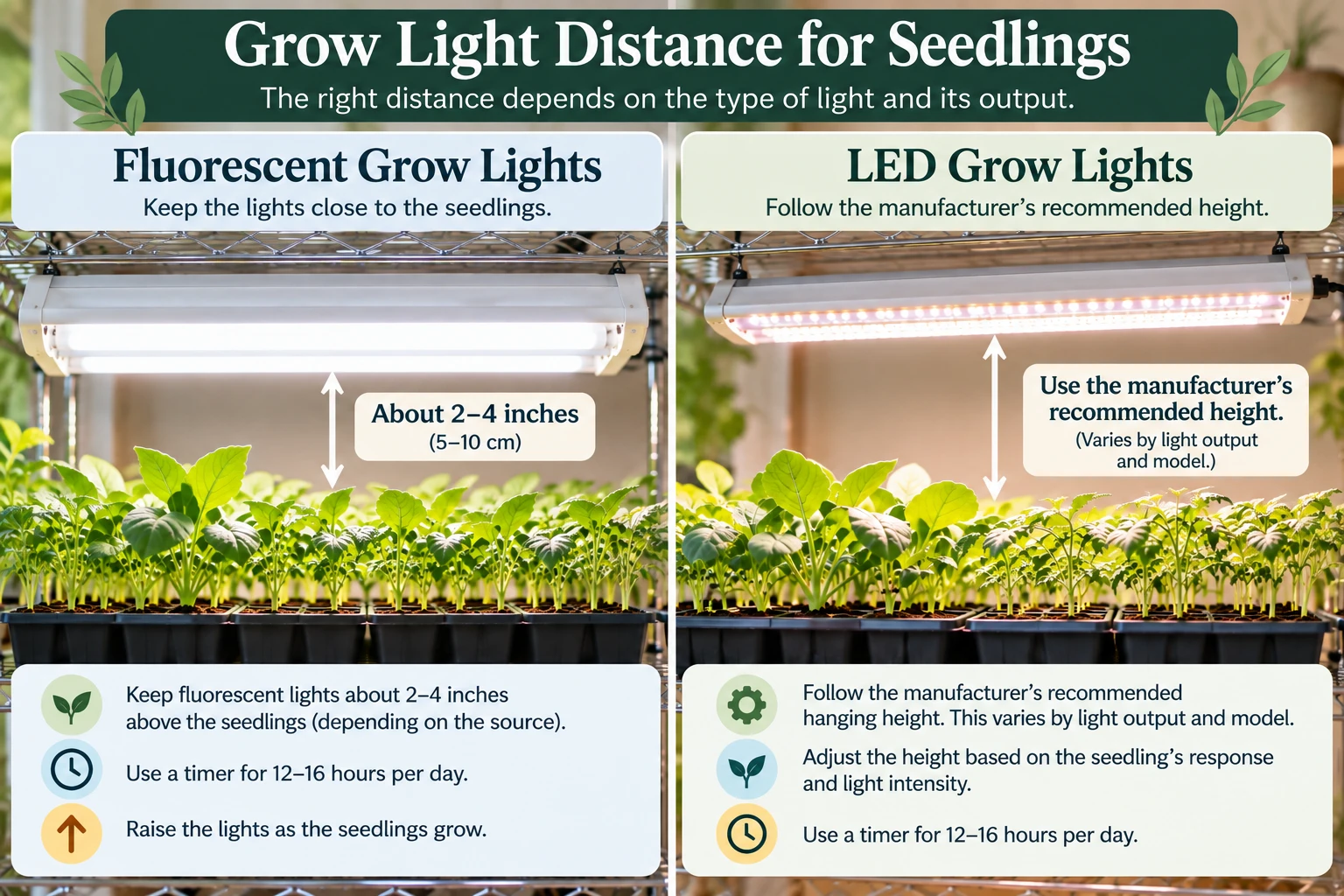
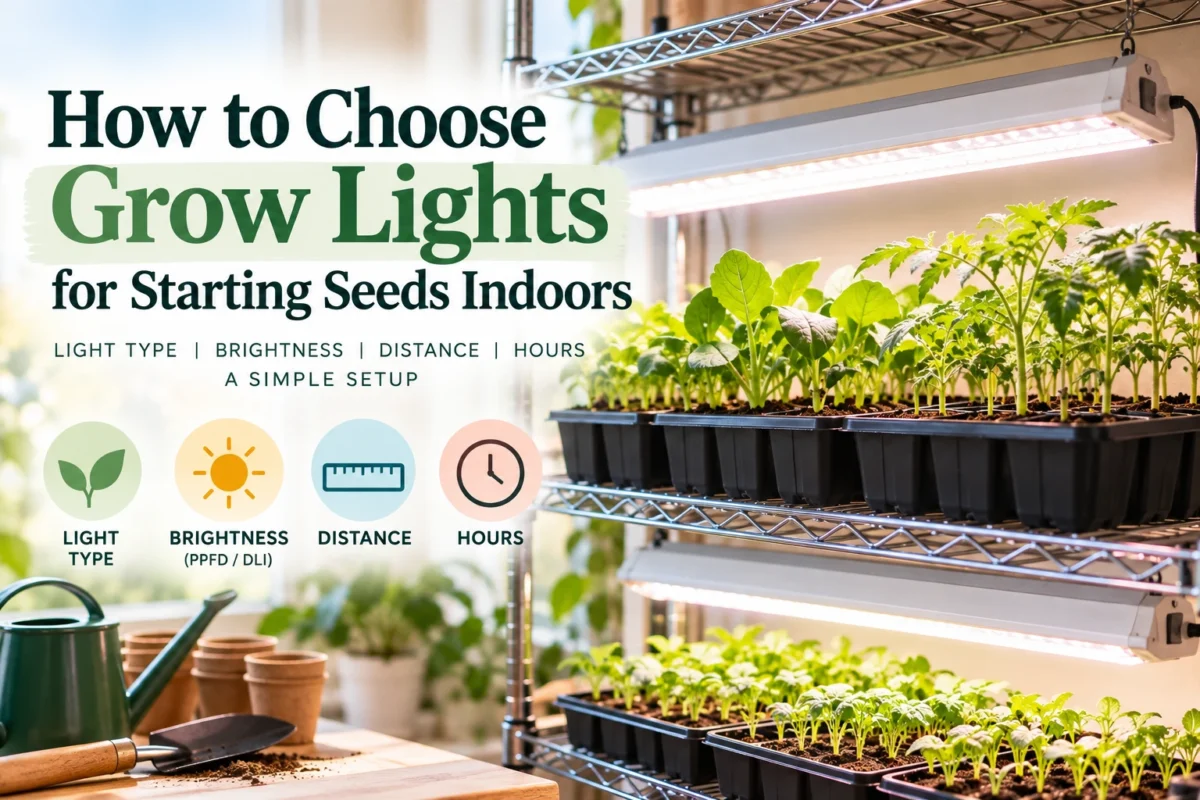
Tap the infographic to view it full size.
This is where sources differ the most, largely because they’re written for different types of lights.
Seedling guides written mainly with fluorescent tubes in mind:
| Source | Distance from light to seedling tops |
|---|---|
| University of Minnesota Extension | No more than 4 inches; “as close as 2 inches is ideal” |
| Clemson HGIC | Start just above the soil line, then keep a 2- to 4-inch gap |
| Iowa State Extension | No more than 4 to 6 inches (fluorescent shop fixture) |
| NDSU Extension | Almost touching after germination, then no more than 4 to 6 inches |
| UW–Madison Extension | About 1 inch from fluorescent tubes |
LEDs are a different case. UW–Madison Extension notes that “Seedlings don’t need to be as close to the lights if you are using LED lights.” Iowa State’s general guidance for indoor plants (not specific to seedlings) puts fluorescent fixtures 6 to 12 inches from the foliage and most LED fixtures 12 to 24 inches away. It gives an example of a full-spectrum, 4-foot LED shop light with at least 3,000 lumens hung 18 inches from the foliage.
Here’s how to put that together:
- Fluorescent tubes: Use the close distances in the table above, and raise the fixture as the seedlings grow.
- LED fixtures: Don’t automatically copy the 2- to 4-inch fluorescent distances, especially with a high-output LED grow light. Start with the manufacturer’s recommended hanging height for seedlings, then adjust based on how the plants respond.
- Either type: If seedlings stretch, lower the light or add a fixture. If leaves look bleached or scorched, raise it. Iowa State’s symptom table recommends exactly these adjustments.
Whatever the starting height, keep the gap consistent as plants grow. UW–Madison warns not to let seedlings grow into the lights, as the leaves may burn.
Put the Light on a Timer
Plug the light into a timer set to your chosen schedule, for example 15 or 16 hours on and 8 to 9 hours off. UMN Extension adds a useful warning: if your lights are on a timer, don’t plug heat mats into the same timer.
A Simple Shelf or Hanging Setup
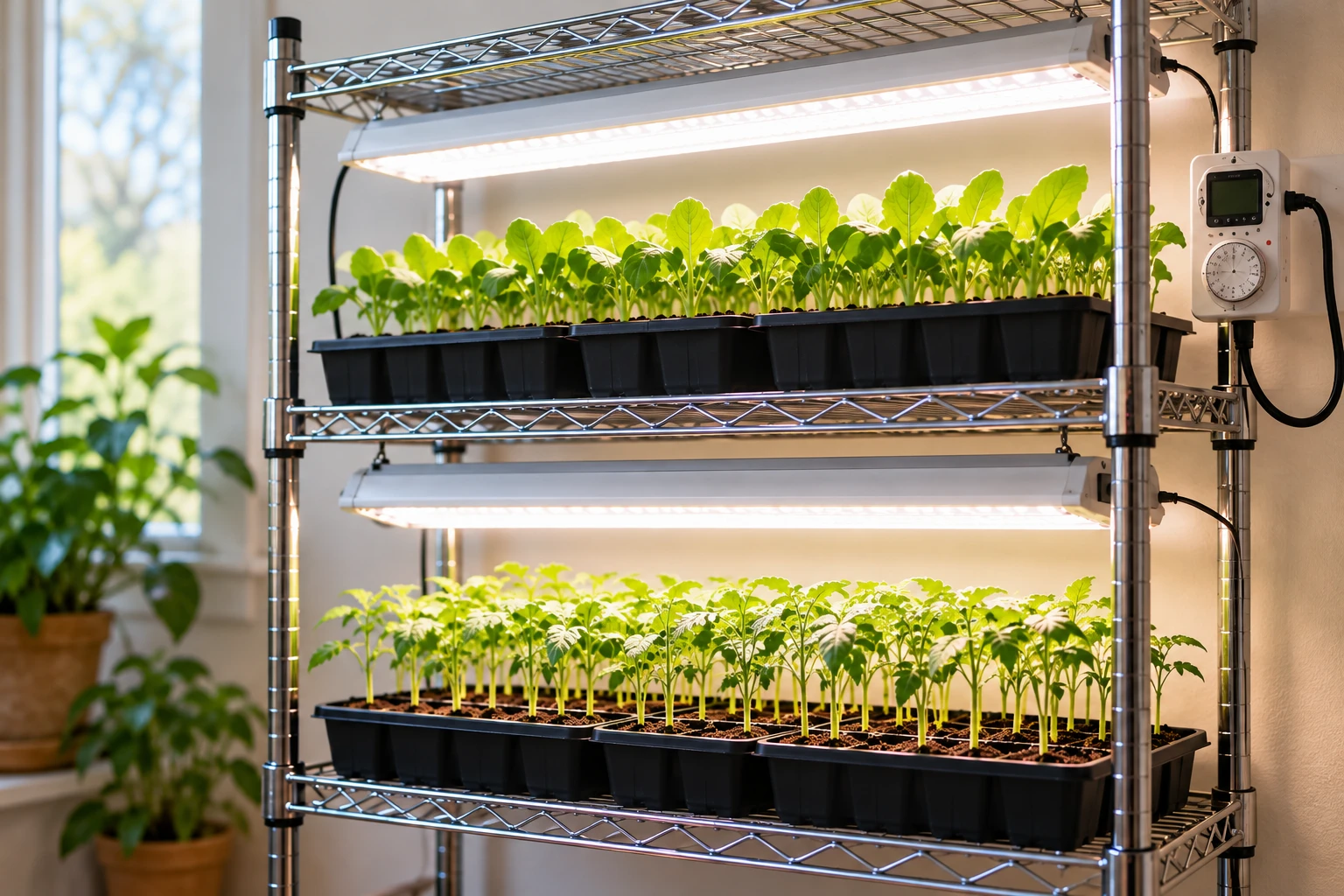
Iowa State describes a common do-it-yourself setup: an adjustable metal shelving unit, a waterproof tray on each shelf, and a light hung from adjustable chains under the shelf above. Ready-made light stands and carts are also available. They’re convenient but often cost hundreds of dollars.
To get more out of the light you have:
- Use reflective surfaces. Clemson HGIC suggests attaching aluminum foil to the fixture to reflect more light onto the plants. Iowa State mentions Mylar or white film around the growing area. Light reflected from the sides is weaker, but it can reach more of the plants.
- Group seedlings of similar height together, so one light height suits the whole tray.
- Keep an eye on plants at the edges. If they stretch more than those directly under the light, move them closer to the center or add reflective material on that side.
Common Grow Light Mistakes
- Hanging the light too high. Light drops off quickly with distance, so a light a foot or more above seedlings may be far too dim, unless it’s a strong LED designed for that height.
- Copying fluorescent distances for a powerful LED. Check the manufacturer’s recommendation first, then watch for bleaching or scorch.
- Leaving lights on 24 hours a day. Plants need a dark period. Iowa State recommends no more than 16 hours of light per day.
- Forgetting to raise the light. Seedlings grow quickly, and leaves touching or nearly touching a fixture can burn.
- Using old fluorescent tubes. Their output fades, so Iowa State recommends replacing them every one to two years.
- Judging a fixture by watts. Compare lumens for shop lights, or PPF and PPFD for grow lights.
- Giving spinach long days. UW–Madison recommends no more than 10 to 11 hours of light for spinach to avoid bolting.
Frequently Asked Questions
How far should grow lights be from seedlings?
It depends on the light. University guides for fluorescent tubes range from about 1 to 6 inches above the seedlings. LEDs can usually hang higher, so start at the manufacturer’s recommended height. See the distance table above for each source.
How many hours of light do seedlings need?
University sources range from 12 to 18 hours a day. About 14 to 16 hours is a practical middle ground, with a dark period every night.
Can I use a regular LED shop light instead of a grow light?
Yes. Iowa State Extension recommends plug-in shop lights for most home gardeners. Choose a full-spectrum fixture with high light output.
Do LED lights need to be as close as fluorescent tubes?
Usually not, according to UW–Madison Extension. Because LED output varies widely, follow the manufacturer’s recommended height and adjust from there.
Should I buy a light that lists PPFD?
It isn’t required, but it makes comparisons easier. A PPFD figure at a stated height lets you estimate the daily light integral with the formula above. For ordinary shop lights, use lumens and the color description instead.
Getting Started
A good seed-starting light doesn’t have to be expensive. A plug-in LED or fluorescent shop light, a way to raise it, and a timer cover the basics. Choose a full-spectrum fixture that covers your trays, compare lumens (or PPF and PPFD for grow lights) instead of watts, start at the right height for your type of light, and keep the lights on for about 14 to 16 hours with a dark break each night.
Ready to put your light to use? Our seed-starting calendar shows when to sow each vegetable based on your last frost date, and our guide on how to start vegetable seeds indoors walks through the rest of the process. If you’re growing herbs indoors, see how to start an herb garden for herb-specific tips.
Sources
- University of Minnesota Extension, “Starting seeds indoors” (reviewed 2026): https://extension.umn.edu/garden-and-home/yard-and-garden/gardening-in-minnesota/starting-seeds-indoors
- Clemson Cooperative Extension Home & Garden Information Center, HGIC 1259 “Starting Seeds Indoors” (revised 2020): https://hgic.clemson.edu/factsheet/starting-seeds-indoors/
- Iowa State University Extension and Outreach, “What type of lights should I use to start seedlings indoors?” (updated 2025): https://yardandgarden.extension.iastate.edu/faq/what-type-lights-should-i-use-start-seedlings-indoors
- Iowa State University Extension and Outreach, “Will a fluorescent light fixture provide sufficient light for seedlings?” (updated 2024): https://yardandgarden.extension.iastate.edu/faq/will-fluorescent-light-fixture-provide-sufficient-light-seedlings
- Iowa State University Extension and Outreach (Aaron Steil), “Growing Indoor Plants Under Supplemental Lights” and related articles (reviewed December 2023): https://yardandgarden.extension.iastate.edu/how-to/growing-indoor-plants-under-supplemental-lights
- NDSU Extension (Carrie Knutson), “Dakota Gardener: Grow Lights for Seed Starting” (2021): https://www.ag.ndsu.edu/news/columns/dakota-gardener/dakota-gardener-grow-lights-for-seed-starting
- University of Wisconsin–Madison Extension (Lisa Johnson), “Timely tips for seedling care” (2023, updated 2024): https://hort.extension.wisc.edu/timely-tips-for-seedling-care/
- University of New Hampshire Cooperative Extension (Jonathan Ebba), “Supplemental Lighting Run Time Worksheet” (2020): https://www.uvm.edu/~entlab/Greenhouse%20IPM/Workshops/2020/Supplemental%20Lighting%20Run%20Time%20Worksheet.pdf
- Huber, B.M., Louws, F.J., and Hernández, R. (2021). “Impact of Different Daily Light Integrals and Carbon Dioxide Concentrations on the Growth, Morphology, and Production Efficiency of Tomato Seedlings.” Frontiers in Plant Science 12: https://www.frontiersin.org/journals/plant-science/articles/10.3389/fpls.2021.615853/full