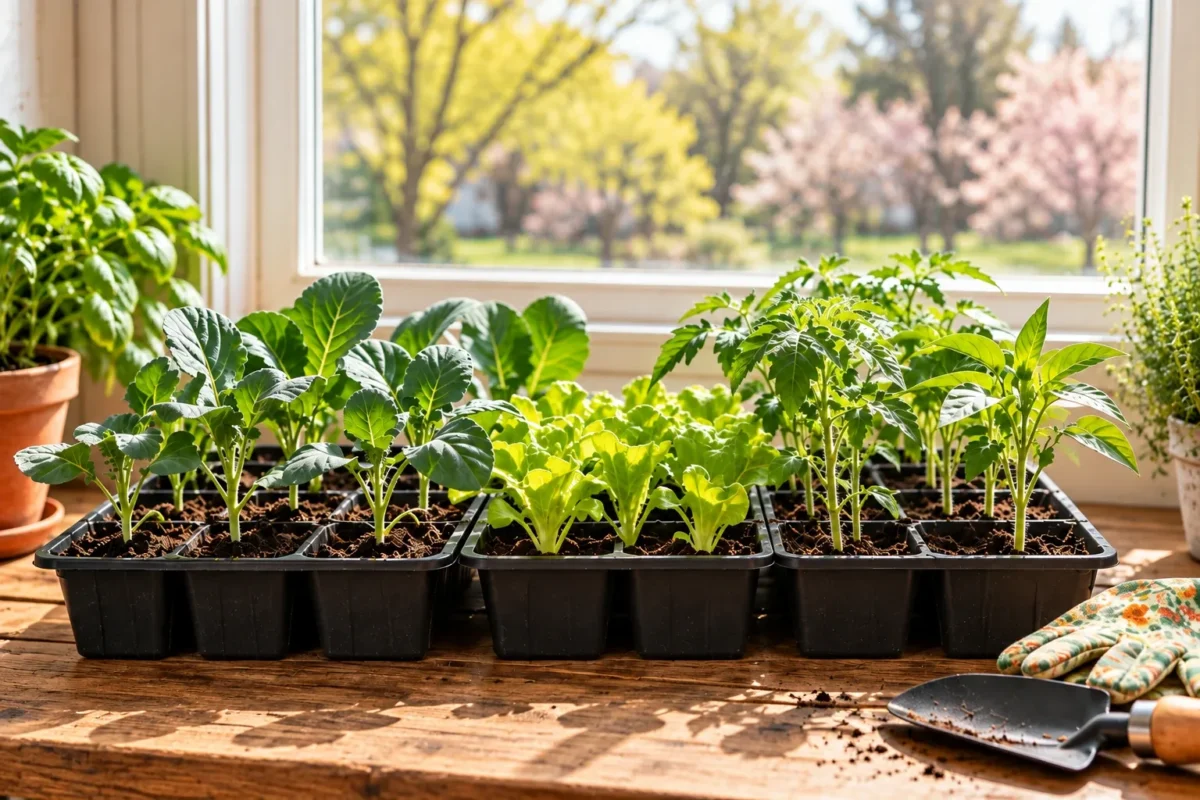
Seed packets often make it sound simple, with instructions along the lines of “Start indoors 6 to 8 weeks before last frost.” But which frost, and what date is that where you live? And is that the day the plants go outside, or just a reference point?
This guide shows you how to turn those packet instructions into actual dates on your own calendar. You’ll find your average last frost date, learn what that date really means, decide when each crop should go outside, and then count back to a sowing date. Along the way, we’ll clear up a common mix-up: your USDA hardiness zone does not tell you when to plant.
If you’re new to growing transplants, our guide on how to start vegetable seeds indoors covers the hands-on steps: containers, seed-starting mix, light, and care. This article focuses on the timing.
The Short Answer: Count Back From Your Transplant Date
Every seed-starting schedule comes down to three steps:
- Find your average last spring frost date. This is a statistical estimate for your location, not a promise.
- Decide when each crop will go outside. Cool-season crops like broccoli can usually be set out before the last frost date. Warm-season crops like tomatoes go out after it.
- Count back by that crop’s indoor growing time. That gives you a window for sowing.
One detail is easy to miss: seed packets and guides don’t all count from the same starting point. Some say “weeks before last frost,” and others say “weeks before transplanting.” Those can be quite different dates, especially for crops that go outside well before or after the frost date. Throughout this guide, we’ll say which one a number refers to.
Step 1: Find Your Average Last Frost Date
Your Hardiness Zone Won’t Tell You This
It’s easy to assume your USDA hardiness zone tells you when spring planting starts. It doesn’t. According to the USDA Plant Hardiness Zone Map, the zones are based on the average annual extreme minimum winter temperature: the coldest temperature a location typically reaches in winter, grouped into 10°F zones and 5°F half zones. The map is meant to help gardeners choose perennial plants that can survive the winter where they live.
Your last spring frost date is a different measurement entirely. It describes when in spring freezing temperatures usually end, not how cold winter gets. Because the two measure different things, two places can share a zone and still have different frost dates. Local factors such as elevation and terrain also affect spring freezes, as you’ll see below.
So be cautious with charts that assign one frost date or one planting schedule to an entire zone. For timing, look up a frost date for your actual location. (For more on what your zone does tell you, see our guide to USDA hardiness zones.)
Where to Look It Up
Frost dates in the U.S. come from long-term weather records. NOAA’s National Centers for Environmental Information (NCEI) publishes U.S. Climate Normals based on 1991–2020 data, and these include spring freeze dates for individual weather stations.
There are a few practical ways to find yours:
- Your local Cooperative Extension office. Many state Extension programs publish frost-date tables or maps for their area, and they can point you to the right local data. This is usually the easiest place to start.
- NOAA’s map on Climate.gov. Climate.gov published an interactive map of the average date of the last spring freeze for weather stations across the country, using the 1991–2020 Normals. It’s a good way to see the general pattern for your region.
- NCEI’s station data. For the most detail, NCEI’s Annual/Seasonal Normals list freeze dates at several probability levels for each station, as described in the next section.
Whichever source you use, pick the station closest to you that has a similar elevation and setting.
What “Average” Really Means: 50% vs. 10% Dates
The “average last frost date” sounds precise, but it’s a probability.
Climate.gov describes the date on its map as “the average date on which the chance of freezing temperatures drops below 50 percent.” In plain terms, on that date there is still close to an even chance that another freeze will come later. Setting out tender seedlings right on the average date means accepting that risk.
NOAA’s Normals also give dates for lower probabilities. NC State Extension’s guide to interpreting freeze probabilities explains how to read them:
- A 50% spring date is a middle-of-the-road estimate: moderate risk.
- A 10% spring date is conservative. A freeze after that date happens in about 1 of every 10 years, on average. NC State describes it as the low-risk choice for gardeners who want to avoid cold damage.
- A 90% spring date is the most aggressive choice. A freeze after that date happens in about 9 of every 10 years.
Climate.gov gives an example from NOAA’s data for one weather station in Boulder, Colorado. There, the date past which the chance of a freeze drops below 50 percent is May 6. To wait until the chance drops below 10 percent, you would wait until after May 18. That’s nearly two weeks of difference for a single location, which is why the probability level you choose matters.
Which date should you use? Climate.gov notes that for tomato seedlings, a “below 50 percent” chance may still feel too risky, and NC State describes the 10% date as the conservative choice. For frost-tender crops like tomatoes and peppers, it’s worth planning around a date later than the 50% date. For cold-tolerant crops, the 50% date is a reasonable reference point.
Freeze vs. Frost
The NOAA freeze dates are based on air temperatures of 32°F or below, measured at weather stations. Frost is a little different. NC State notes that frost depends on humidity as well as temperature, so it doesn’t have a single threshold, and a freeze can happen without frost, or the reverse. The Illinois State Climatologist points out that frost can form on plants even when the reported air temperature is 34 or 35°F, because surfaces near the ground can be colder than the air measured higher up.
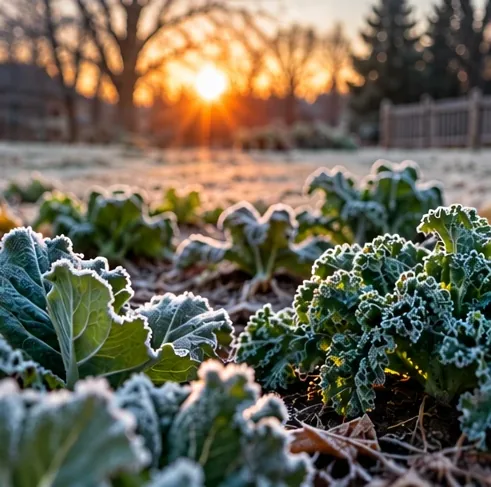
The takeaway: treat the frost date as a guide, not a guarantee.
Why Your Yard May Differ
Even a good station-based frost date can miss what happens in your own garden. A few factors that shift frost timing:
- Latitude and elevation. Climate.gov notes that the farther north or higher in elevation you go, the later the last freeze generally arrives.
- Slope and exposure. NC State Extension in Buncombe County notes that dates vary with elevation and which side of a mountain your garden is on, and that south-facing sites warm sooner than north-facing slopes.
- Low spots and calm nights. The Illinois State Climatologist notes that most late frosts happen on calm, clear, cold nights, that cold air can settle in low-lying areas to form “frost pockets,” and that nearby locations can differ quite a bit.
None of this means the frost date is useless. It means you should use it to plan, then watch the forecast for your area as planting day gets close.
Step 2: Decide When Each Crop Goes Outside
Your frost date is the reference point, but each crop has its own time to go outside. It’s easy to overlook: a tomato and a broccoli plant usually shouldn’t go into the garden on the same day.
Cool-Season Crops: Before the Last Frost
Crops like broccoli, cabbage, cauliflower, kale, onions, and lettuce tolerate cool weather. Iowa State University Extension notes that cool-season vegetables “can be planted outside several weeks before the last expected frost date.”
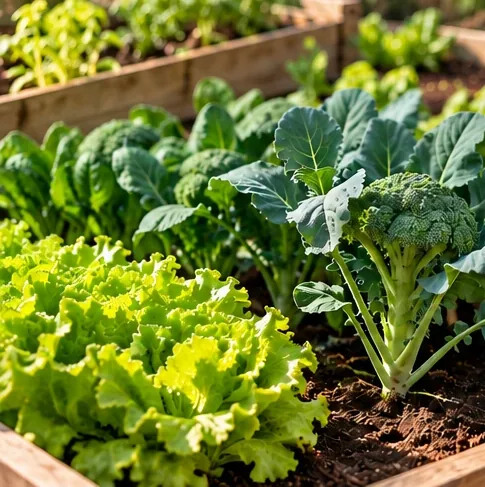
Specific timing varies by crop and source. For example:
- Broccoli: Utah State University Extension says transplants may be planted 2 to 3 weeks before the last frost-free date for your area.
- Kale: Utah State says transplants should be planted 4 to 5 weeks before the last frost-free date.
- Lettuce: Utah State suggests planting lettuce transplants near the last frost-free date.
Cool-season crops also need to mature before summer heat. Clemson Extension’s garden planning guide notes that they grow poorly in summer heat, so getting them out on time matters.
Warm-Season Crops: After the Last Frost
Tomatoes, peppers, eggplant, cucumbers, squash, and melons are frost-sensitive. Clemson Extension’s guidance is that warm-season crops shouldn’t be planted outdoors in spring without protection until the danger of freezing temperatures has passed.
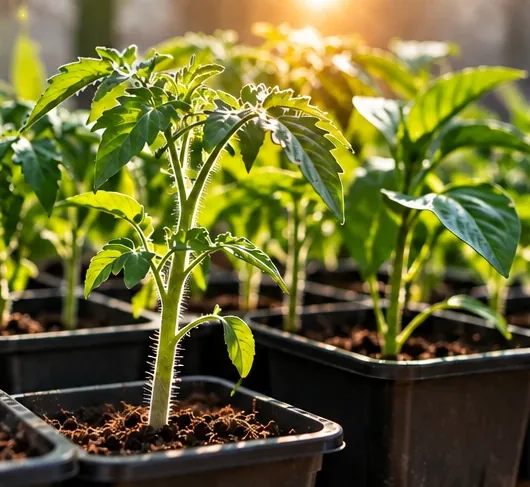
Many Extension programs also look at warmth, not just the calendar:
- Tomatoes: University of Minnesota Extension advises transplanting “after all danger of frost has passed and the soil has warmed.”
- Peppers: UMN suggests transplanting peppers once nighttime lows are above 50°F.
So for warm-season crops, your transplant date is usually some time after your frost date, depending on your weather that year.
Don’t Forget Hardening Off
Seedlings raised indoors need a gradual transition to sun, wind, and cooler nights before they go into the garden. Recommendations range from about one to three weeks: Iowa State says to add “a week or two for hardening off,” and Clemson describes two to three weeks of conditioning. Our seed-starting guide walks through the hardening-off steps.
Some sources count hardening off inside their indoor growing times, and others add it on top. If your schedule doesn’t already include it, build in that extra time.
Step 3: Count Back — The Seed-Starting Calendar
Once you have a transplant date for each crop, subtract the indoor growing time to find your sowing window. The table below combines transplant timing with indoor growing times from several university Extension programs. These are ranges, not exact rules, and they come from different regions, so use them as a starting point and check your seed packet for your specific variety.
| Crop | When it usually goes outside | Indoor growing time (sowing to transplanting) |
|---|---|---|
| Tomatoes | After the last frost, once the soil has warmed | 6–8 weeks (Clemson, UMass); 5–6 weeks (UMN) |
| Peppers | After the last frost; UMN suggests nights above 50°F | 8–10 weeks (Clemson); 6–8 weeks (UMass); about 8 weeks (UMN) |
| Eggplant | After the last frost | 6–8 weeks (Clemson); 7–9 weeks (UMass) |
| Cucumbers, squash, melons | After the last frost | 3–5 weeks (Clemson); 2–3 weeks (UMass) |
| Broccoli, cabbage, cauliflower | Before the last frost; Utah State: broccoli 2–3 weeks before | 5–7 weeks (Clemson); 4–7 weeks (UMass); broccoli 6–7 weeks (Utah State) |
| Kale | Before the last frost; Utah State: 4–5 weeks before | 5–7 weeks (Clemson); 5–6 weeks (Utah State) |
| Collards | Early spring; Clemson gives regional calendar dates, not a frost-based rule | 5–7 weeks (Clemson HGIC 1259); 6–8 weeks (Clemson HGIC 1307) |
| Lettuce | Near the last frost date (Utah State) | 5–7 weeks (Clemson); 3–5 weeks (UMass); 5–6 weeks (Utah State) |
| Onions | Early in the season; regional calendar dates (Utah State: April; UMN: May in Minnesota) | 6–8 weeks (UMass); about 8 weeks (Utah State); 10–12 weeks (UMN) |
Sources: Clemson HGIC: Starting Seeds Indoors and Collards, UMass Amherst: Starting Seeds Indoors, University of Minnesota Extension crop guides, and Utah State University Extension fact sheets on broccoli, kale, lettuce, and onions.
A couple of notes on reading the table:
- The ranges overlap but don’t match. Different programs write for different climates and measure slightly differently. Onions show this clearly: indoor times range from 6–8 weeks (UMass) to 10–12 weeks (UMN), and the Utah State and UMN guides give calendar months for their own regions rather than a frost-based rule. If your seed packet gives a number, it’s specific to that variety, so it’s worth following.
- Bigger isn’t better. UMN notes that tomato plants started earlier “are difficult to manage and do not necessarily lead to better or earlier harvests,” and Utah State warns that broccoli transplants that are too large and mature are prone to “buttoning”: forming small, early heads.
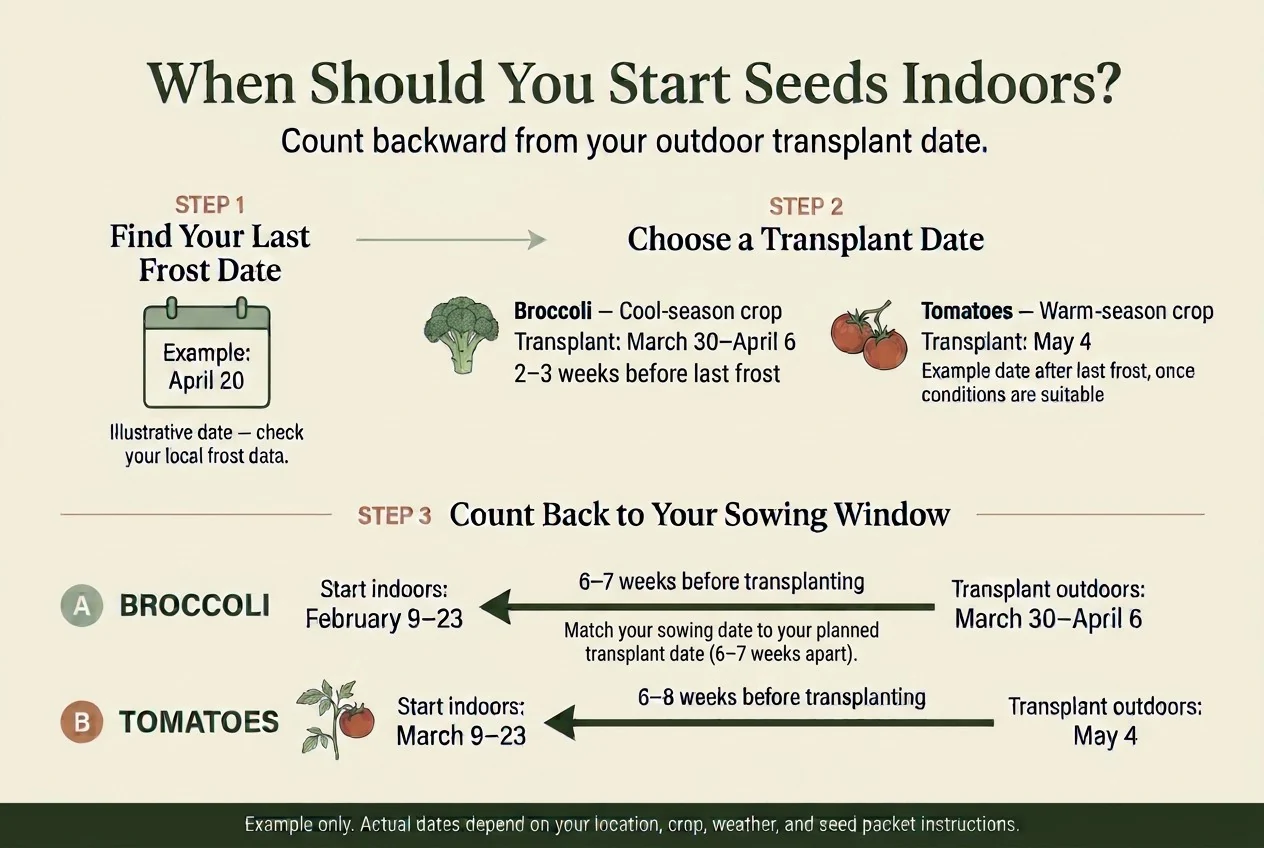
Tap the infographic to view it full size.
A Worked Example
To see how the math works, here’s an example using a made-up average last frost date of April 20. This date is only for illustration. It isn’t a recommendation for any region, so plug in your own date instead.
Broccoli (cool-season)
- Goes outside 2 to 3 weeks before the frost date (Utah State): March 30 to April 6
- Indoor growing time of 6 to 7 weeks (Utah State)
- Sowing window: about February 9 to February 23
Lettuce (cool-season)
- Goes outside near the frost date (Utah State): around April 20
- Indoor growing time of 5 to 6 weeks (Utah State)
- Sowing window: about March 9 to March 16
Tomatoes (warm-season)
- Goes outside after the frost date, once the soil has warmed. In this example, say you choose May 4, two weeks after the frost date. (Your real date depends on your soil temperatures and forecast.)
- Indoor growing time of 6 to 8 weeks (Clemson)
- Sowing window: about March 9 to March 23
Peppers (warm-season)
- Same example transplant date of May 4
- Indoor growing time of 8 to 10 weeks (Clemson)
- Sowing window: about February 23 to March 9
Notice that broccoli is sown about four weeks before tomatoes, even though the two need a similar amount of time indoors. That’s because broccoli goes outside about four to five weeks earlier.
If you use a more conservative frost date (such as your 10% date), every transplant and sowing date in this example shifts later by the same number of days. And if your indoor times don’t already include hardening off, adjust for that as described above.
Crops You Should Sow Directly Instead
Not everything benefits from a head start indoors. UMass Amherst recommends sowing peas, beans, corn, mesclun mix, root crops, and spinach directly into the garden, and Clemson lists beans, corn, and carrots among crops better sown in place. These go into your outdoor calendar instead, based on soil conditions and the frost date.
Adjusting the Calendar for Your Region
The three-step method works anywhere, but the dates it produces vary a lot across the U.S.
Northern and High-Elevation Gardens
In colder regions, the last frost can come late. University of Minnesota Extension, for example, advises waiting until after the last frost, which it places in mid-to-late May for Minnesota, before transplanting tomatoes, eggplants, and peppers. UMN puts tomato sowing at about mid-April for most of the state. At higher elevations, frost dates can be later than nearby lowland areas.
Southern and Coastal Gardens
In warmer regions, spring planting starts earlier, and the season can look quite different from one part of a state to another. Clemson’s garden planning guide divides South Carolina into two regions with different planting windows. For example, its recommended spring window for setting out tomatoes is earlier in the Coastal Plain than in the Piedmont. The same chart also lists fall planting windows, since cool-season crops can be grown again as summer heat fades.
Fall Crops Have Their Own Calendar
Cool-season crops can also be grown for a fall harvest, which means a separate sowing schedule counted back from the first fall frost instead of the last spring frost. UMN notes that cabbage and broccoli intended for fall crops may be started indoors in June or July in Minnesota, and Clemson’s planting chart includes fall planting windows for cool-season crops in South Carolina. Your local Extension office can give you a fall planting calendar for your area.
Common Timing Mistakes
- Starting too early. Iowa State’s advice is simple: “Don’t sow your seeds too early!” Stick to your sowing window rather than starting weeks ahead of it.
- Treating the average frost date as a safe date. At the 50% level, a later freeze is still close to an even chance. For tender crops, consider a more conservative date and keep an eye on the forecast.
- Using one date for every crop. Cool-season crops can usually go out before the frost date, while warm-season crops wait until after it, so their sowing dates differ too.
- Leaving out hardening off. If your indoor times don’t already include it, add a week or more to your plan.
Frequently Asked Questions
Is my last frost date the same as my hardiness zone?
No. Your USDA hardiness zone is based on average annual extreme minimum winter temperatures and is mainly used for choosing perennials that survive winter. Your last frost date is a separate estimate of when spring freezes typically end. Look up both separately.
My seed packet says “weeks before transplanting.” How is that different from “weeks before last frost”?
“Weeks before transplanting” counts back from the day the plant goes outside. “Weeks before last frost” counts back from the frost date. For a crop that goes out right around the frost date, they’re similar. For broccoli (out before the frost date) or peppers (out after it), they can differ by several weeks. Find out which one your source means before you count.
What if a frost is forecast after I’ve planted?
Late frosts do happen. NC State’s Buncombe County Extension suggests protecting plants with row covers, cold frames, or cloches, and notes that keeping plants well watered and mulched can also help. Watching the forecast for a few weeks after planting is a good habit.
Can I start seeds earlier if I have a good indoor setup?
Good light and warmth help seedlings grow well, but they don’t change when it’s safe to transplant outside. Starting well ahead of the window just means larger plants waiting indoors longer, and as noted above, UMN and Utah State both point out downsides to oversized transplants.
Getting Started
Here’s a simple way to put this into practice:
- Look up your average last frost date through your local Extension office or NOAA’s freeze data, and decide whether to plan around the 50% date or a more conservative one.
- List the crops you want to start indoors, and mark each one as cool-season or warm-season.
- Set a transplant date for each crop, then count back by its indoor growing time. Write the sowing windows on a calendar.
Once your dates are set, our guide on how to start vegetable seeds indoors covers what to do on sowing day and after. If you’re setting up lights for the first time, see how to choose grow lights for starting seeds indoors. To gather supplies before sowing day, our seed starting supplies checklist sorts what you really need from what you can skip. If you’re still planning your first garden, starting a vegetable garden from scratch walks through choosing a spot and preparing the soil.
Sources
- USDA Agricultural Research Service: USDA Plant Hardiness Zone Map
- NOAA Climate.gov (Rebecca Lindsey; archived page): Interactive map: Average date of last spring freeze across the United States
- NC State Extension (Nelson, El-Khoury, and Boyette), AG-873: Interpreting Freeze/Frost Probabilities from the National Centers for Environmental Information
- N.C. Cooperative Extension, Buncombe County Center (Alison Arnold): Last Frost in the Garden?
- Illinois State Climatologist (Jim Angel): Frost Climatology in Illinois
- Iowa State University Extension and Outreach (Aaron Steil): Can I Start My Seeds Indoors Yet?
- Clemson Cooperative Extension HGIC: Starting Seeds Indoors, Planning a Garden, and Collards
- UMass Amherst Center for Agriculture, Food, and the Environment: Starting Seeds Indoors
- University of Minnesota Extension: Starting seeds indoors, Planting the vegetable garden, Growing tomatoes, Growing peppers, Growing onions
- Utah State University Extension (Dan Drost and Michael Johnson): Broccoli in the Garden and How to Grow Kale in Your Garden; (Dan Drost): How to Grow Lettuce in Your Garden and How to Grow Onions in Your Garden